Background:
People living with HIV (PLWH) show a marked shortening of blood telomere length (BTL) early after seroconversion. This is caused by uncontrolled viral replication with sustained immune activation, immunosenescence and inhibition of telomerase by HIV proteins. Antiretroviral therapy (ART) causes an increase in naïve and central memory cells that have longer telomeres, leading to an overall BTL increase. However, tenofovir (TDF/TAF) and abacavir (ABC), which are potent inhibitors of human telomerase activity, have been shown to negatively affect the BTL increase. We investigated the effect on BTL over 96 weeks after starting a dual therapy (DT) with dolutegravir (DTG) plus lamivudine (3TC) vs a standard triple therapy (TT) with an anchor drug plus two NRTIs, one of which was TDF/TAF or ABC.
Methods:
In this prospective longitudinal study we enrolled ART-naïve PLWH who started DT or TT, with no current AIDS event. We assessed BTL by monochrome multiplex qPCR (expressed as telomere to single-copy gene ratio, T/S) at the time of ART initiation (baseline, BL), virological success (VS) (achievement of HIV-RNA<50cps/mL), and at weeks 48 (W48) and 96 (W96). We used an adjusted mixed model (GLM) to evaluate the effects of both the between- and within-subject factors. Linear regressions were performed to identify the variables associated with BL BTL and BTL changes over W96.
Results:
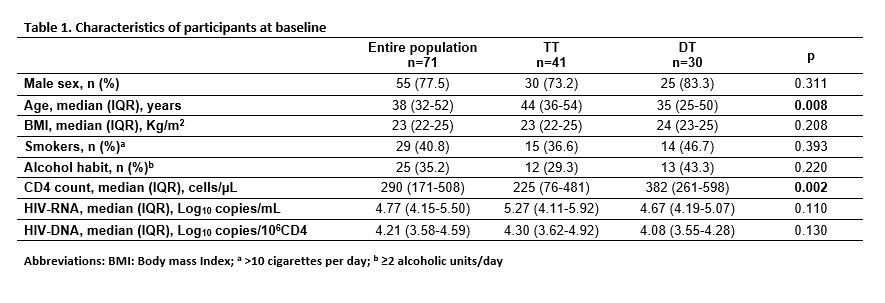
From 2018-2022 we enrolled 71 participants: 41 in the TT and 30 in the DT group (Table1). Compared to TT, participants in DT were younger and with higher CD4 count. However, the two groups showed comparable BL HIV-RNA and HIV-DNA load, they similarly reached VS within 2 months and maintained viral suppression over the follow-up. At BL, the medians (IQR) of BTL were similar in the TT and DT groups: 0.93 (0.79-1.09) and 1.06 (0.84-1.19) (p=0.103). Overall, BTL increased over time, showing a similar trend in both groups (p=0.769); specifically, we observed no variation up to W48 (+0.02, p=0.803) and a significant mean gain at W96 (+0.11, p=0.015). BL BTL was associated with younger age (-0.07 per 10 yr. increase; -0.11/-0.02; p=0.004). Higher BTL change was associated with shorter BL BTL (-0.90; -1.20/-0.60; p<0.001).
Conclusions:
In this setting, ART-naïve PLWH who initiated either DT or TT showed a similar evolution of BTL over time. They did not show any significant change in BTL after 1-year follow-up,. However, a gain was observed at W96, suggesting a beneficial effect of ART, regardless of triple or dual regimen use.