Background:
The Loire Valley region is a low-density demographic and medical region with the second most elevated rate of positive HIV testing in France (1.4/1000 screening) after Paris, despite a low testing rate (60/1000 inhabitants). Among new HIV diagnoses, 40% are men having sex with men (MSM) and 43% are heterosexuals (HET) born abroad. We investigated the role and characteristics of transmission clusters in the HIV dynamics in this region close to the fast-track city of Paris for appropriate local response.
Methods:
1305 HIV pol gene sequences collected in Loire Valley region over a decade (2010-2020) were included in a phylogenetic analysis combined with epidemiological data. Putative transmission clusters were inferred using HIV TRACE methods (≤0.015 substitutions/site, Tamura Nei 93 substitution model). Risk factors of being part of a cluster were studied using an uni- and multi-variate logistic regression model.
Results:
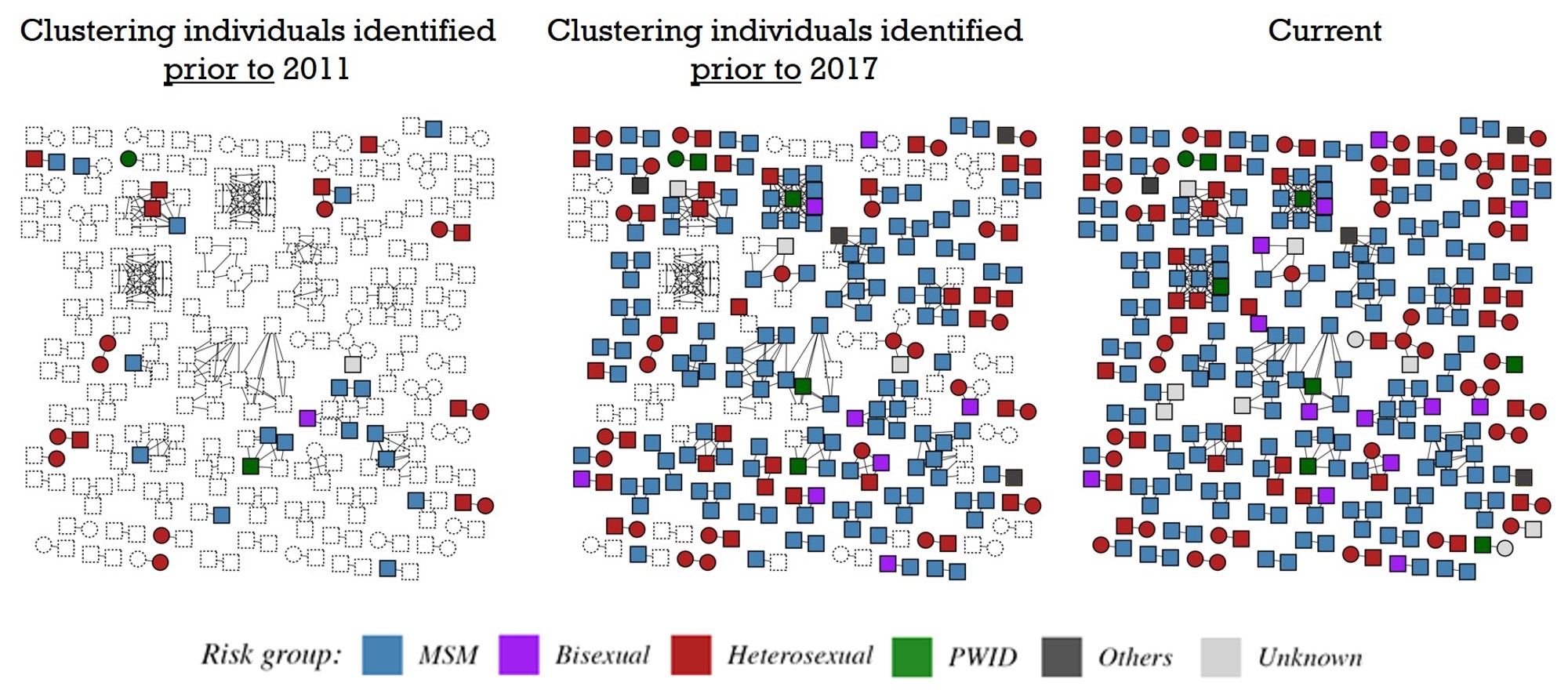
Of the 1,305 participants, 44% (n=579) were born out of France, including 36% originating from Sub-Saharan Africa (SSA), 494 (38%) were women, 433 (33%) MSM, 694 (53%) HET. Migrants had lower CD4 cell count at diagnosis than those born in France (296 vs 443, p< 0.01), likely due to delayed time to diagnosis, and were mainly women (62%). A total of 86 clusters were identified (Nf276 sequences, clustering rate of 21%) including 33 of N ≥ 3 linking 170 participants (3-16 per cluster), and 53 dyads (Figure 1). We identified risk factors of clustering: MSM born in France (OR 2.57, p< 0.01), higher viral load (OR 1.39, p< 0.01) and residency in one administrative division of the region (OR 3.17, p< 0.05). HET from SSA were at lower risk than those born in France (OR 0.01, p < 0.01). Among large clusters of N≥7, virological control was achieved in a median of 75% of people per cluster (IQR 74-87) vs 84% for the total cohort. Fourteen clusters were still growing after 2017 despite PrEP availability.
Conclusions:
In Loire Valley region, we found that French-born MSM were part of local transmission networks but not HET migrants, suggesting a two-compartment HIV dynamic. Delayed diagnosis or infection before settling in the region could lead to under-representation of migrants in cluster analysis. Locally, epidemic control would require further implementation of PrEP and TASP in MSM to slow the dynamics of HIV clusters and generalized access to HIV screening for migrants. The same actions are promoted by the Paris Sans SIDA initiative and should be extended to neighboring territories.