Background:
With the introduction of direct-acting antivirals (DAAs), most individuals with hepatitis C virus (HCV) can be cured with well-tolerated regimens. Given more simplified treatments with higher cure rates compared to interferon (IFN)-based therapy, men who have sex with men (MSM) may be less prone to behavioral changes following HCV treatment.
Methods:
Data from the Dutch observational MOSAIC study between 2009 and 2017 were used. We included MSM with HIV aged ≥18 years who received any HCV treatment. We evaluated risk behavior through a validated HCV risk score (HCV-MOSAIC score=0-7) and individual risk behaviors included in this score (i.e., condomless receptive anal intercourse, sharing sex toys, sharing straws, unprotected fisting, injecting drug use (IDU) and ulcerative STI). Levels of risk behavior before, during and after HCV treatment were stratified by treatment type and modeled using linear/logistic regression with Generalized Estimating Equations. Changes in behavior post treatment were investigated in a separate model, while comparing treatment regimens.
Results:
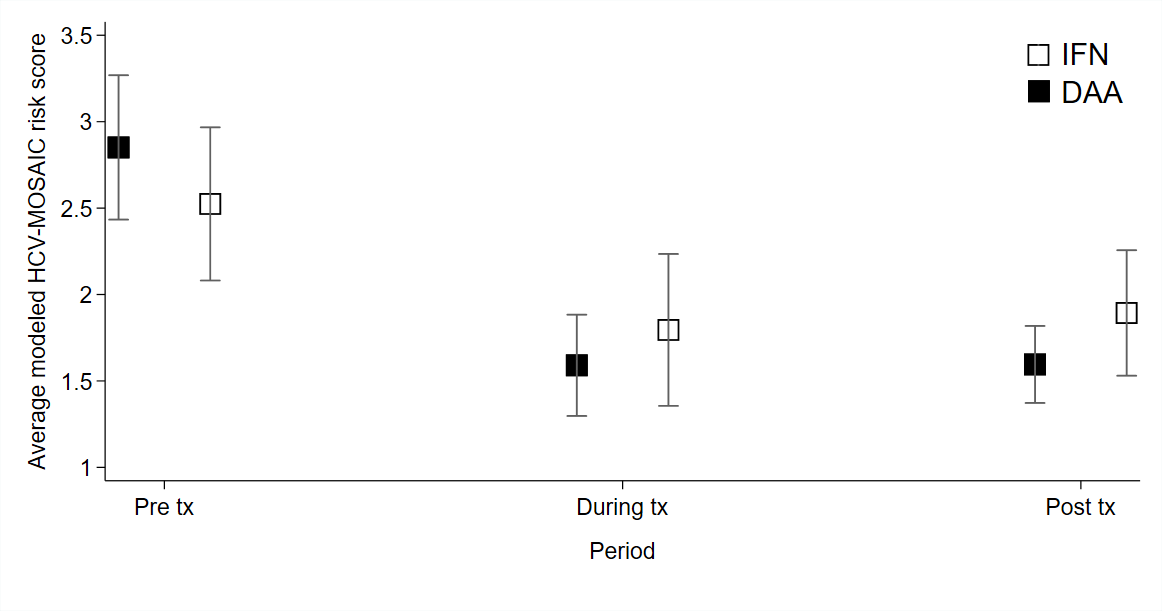
Of 143 study participants, 131 MSM were included with 157 infections. Median total follow-up was 29 months (IQR=10-54). Median age at first visit was 45 years (IQR=40-50); 78.6% were born in the Netherlands. For MSM treated with IFN-based treatment, the average risk score decreased from 2.9 (95%CI=2.4-3.3) pre-treatment to 1.6 (95%CI=1.3-1.9) during treatment and remained stable afterwards (1.6, 95%CI=1.4-1.8). For MSM treated with DAAs, the average risk score decreased from 2.5 (95%CI=2.1-2.9) pre-treatment to 1.8 (95%CI=1.3-2.2) during treatment and 1.9 (95%CI=1.5-2.2) post-treatment (Figure 1). There was no evidence of overall differences in risk scores between treatment regimen across timepoints (p>0.05). For individual risk behaviors, the proportion of IDU differed significantly between treatment regimen across timepoints (p=0.03). There were no changes in risk scores or proportion of individuals engaging in individual risk behavior post treatment for either treated regimen (p >0.05)
Conclusions:
In MSM with HIV-HCV, we found no difference in behavioral patterns, either from the HCV-MOSAIC score or for most individual behaviors, between IFN and DAA regimens. Nevertheless, a large proportion of individuals treated with DAAs are at risk of HCV reinfection (i.e., score ≥2.0) post-treatment, underscoring the need for ongoing HCV testing and behavioral interventions.
Average modeled HCV risk score pre-, during and post-treatment among MSM treated with IFN and DAAs