Background:
In Kenya, estimated HIV incidence is substantially higher among young female sex workers (YFSW) compared to similar-age women not engaged in sex work (2.2% vs. 0.15%). Pre-exposure prophylaxis (PrEP) for HIV prevention is recommended for at-risk populations, but its effectiveness requires consistent access and adherence. We assessed the effectiveness of two behavioral and structural interventions on PrEP adherence among YFSW in Kisumu, Kenya. Study follow-up (F/U) coincided with national restrictions on travel and gatherings due to the COVID-19 pandemic.
Methods:
We conducted an unblinded, randomized-controlled trial enrolling 18-24 year-old HIV-negative YFSW with no current or recent PrEP use. Participants were provided oral PrEP and randomized to either weekly adherence support from a trained peer supporter (PS), or SMS reminders and resource transfer (RRT) for 12 months, and received PrEP with no adherence support interventions for another 12 months to assess durability of our interventions. Primary outcomes compared adherence in study arms via detectable metabolites in whole blood samples and self-report at 12, 18, and 24 months of F/U. We conducted an intention-to-treat analysis of differences in intervention effectiveness at months 12, 18 and 24. Sensitivity analyses used inverse probability weighting with stabilized weights to correct for selection bias due to lost to F/U.
Results:
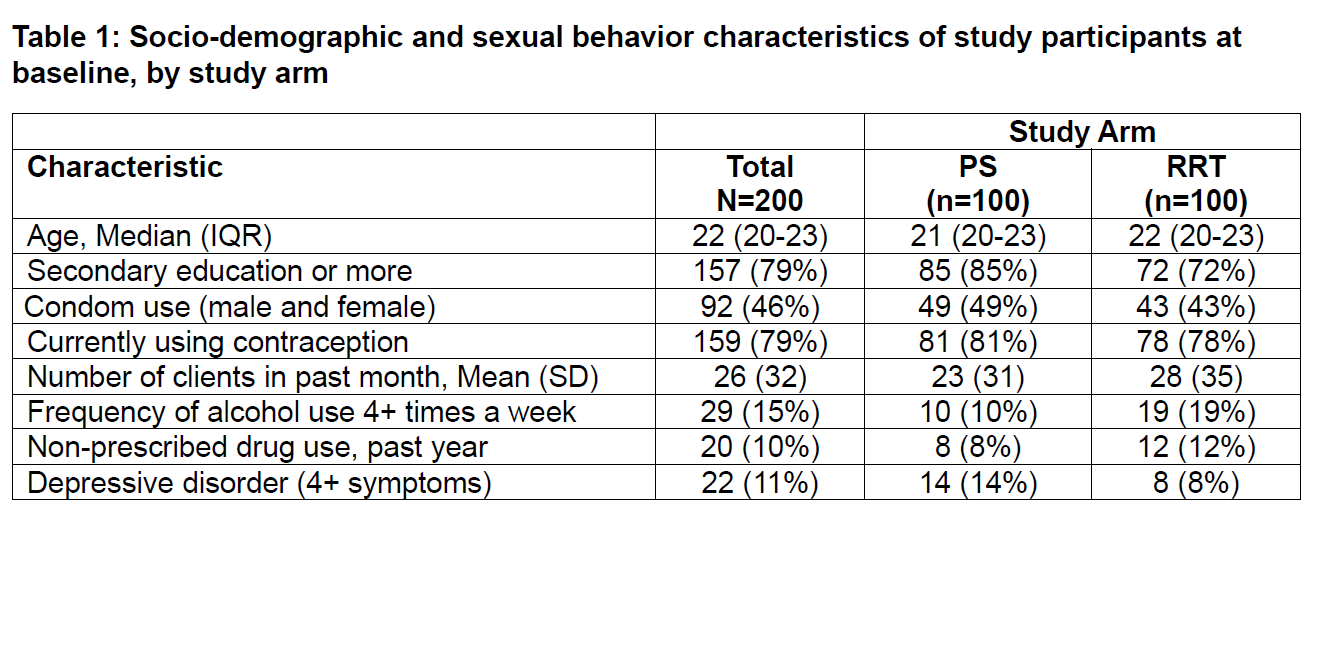
We screened 289 YFSW and enrolled 200 (100 per arm). Socio-demographic and sexual behavior characteristics are presented in Table 1. At 12-month F/U (n=179), 86% in PS and 93% in RRT arms reported decreases in number of weekly clients. At 12, 18, and 24 months, detectable levels of PrEP were 3%, 1%, and 0% in the PS arm compared to 9%, 9%, and 1% in the RRT (p-value = 0.4). Our sensitivity analysis found similar results. In contrast, 85%, 81% and 83% in the PS arm, and 86%, 87% and 76% in the RRT arm self-reported perfect 7-day adherence at months 12, 18 and 24, respectively. Two seroconversions were identified; one at 12- and one at 18-months F/U.
Conclusions:
In this population of YFSW, no difference in adherence by drug levels or self-report was noted across study arms. The very low levels of drug metabolites in contrast to high self-reported adherence may be due to perceived lower HIV risk resulting from decreased sex work during COVID-19 and to socially desirable responses. Findings highlight the urgent need for long-acting PrEP for this population.