Background:
Broadly neutralizing antibodies (bnAbs) are important tools for HIV-1 therapy and cure strategies, yet the role of autologous neutralizing antibodies (anAbs) during bnAb therapy is unclear. We studied the kinetics of anAb responses during VRC07523.LS therapy at analytical treatment interruption (ATI) in a robust SHIV-infected Rhesus Macaque (RM) model of HIV-1.
Methods:
18 RMs infected IV with 1×10⁶ infectious units of SHIV.D.191859 (SHIV.D) initiated antiretroviral therapy (ART) at 120 days post-infection (dpi). After 6 months of ART, all 18 RM underwent ATI, during which 9 were administered 30 mg/kg VRC07.523LS. Plasma virus env sequences were derived by single genome sequencing. SHIV.D and rebound Envs were tested for neutralization sensitivity.
Results:
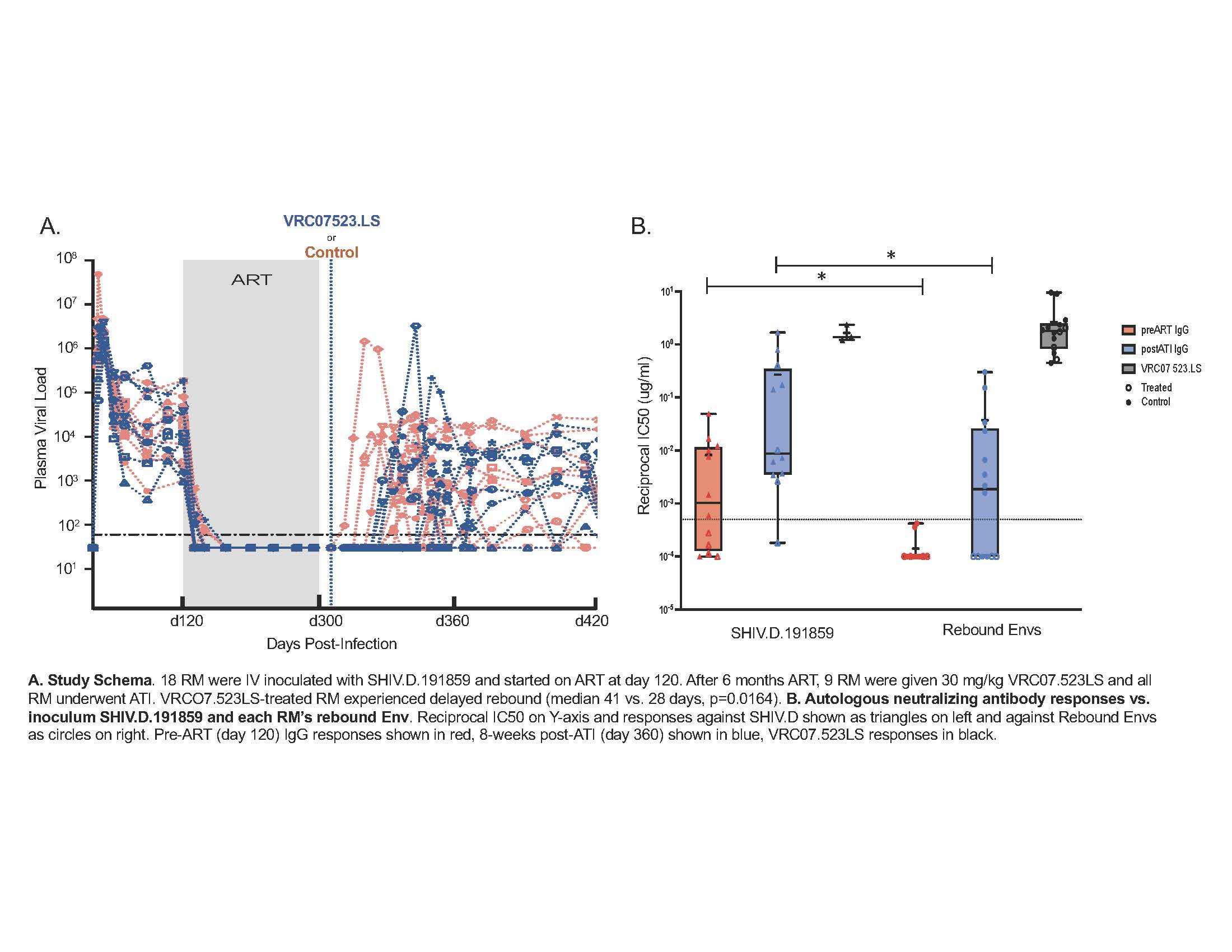
18 RM experienced peak and pre-ART viral loads of 4.91×10⁶ and 3.94×10⁴ copies/mL, respectively. Virus was suppressed within 3 weeks of ART and rebounded in all RM following ATI, with a significant delay in VRC07.523LS-treated RM (median 41 vs. 28 days, p=0.016). At 120dpi, 56% (10/18) of RMs had detectable anAb responses against SHIV.D, with median 50% inhibition of 1:47 plasma dilutions (ID50) and 87 µg/mL IgG (IC50), with strong correlation between plasma and IgG (rs =0.85, p=1E-5). AnAb responses were stable over 6 months of ART. Plasma virus env sequenced pre-ART and at rebound (median 31 sequences per RM) revealed 1-5 virus lineages at rebound. Rebound Envs were universally resistant to 120dpi plasma IgG (p=0.0051, vs. SHIV.D anAbs). Eight weeks post-rebound, plasma anAb responses rose up to 1000-fold against both SHIV.D and rebound Envs, with greater magnitude vs. SHIV.D than rebound Envs (p=0.0053). In treated RMs, plasma VRC07523.LS was detectable at rebound in 7/9 RM and undetectable 8 weeks post-ATI in 9/9. Rebound Envs in bnAb-treated RM were more VRC07523.LS-resistant than controls (p=0.0316). Modeling of virus evolution indicated similar rates of virus diversification in treated and control RM.
Conclusions:
SHIV.D-infected RMs demonstrate viral kinetics, anAb responses, and effects of CD4bs bnAb monotherapy that closely mirror human trials. Rebound virus escaped baseline anAb responses, suggesting ongoing humoral immune pressure at ATI. Virus rebound preferentially boosted anAbs against inoculum vs. rebound virus, indicating antibody imprinting, or original antigenic sin. AnAb potencies approaching those of VRC07.523LS suggest a potential role for anAbs to restrict archived virus and complement bnAb-based interventions.
SHIV.D Study Schema and Autologous Neutralizing Antibody Responses