Background:
Chronic inflammation may be associated with the development of cognitive disorders. We examine the associations between changes in cognitive function (CF) scores and plasma biomarkers of neuronal injury, systemic inflammation and innate immune activation measured in people with HIV (PWH) and demographically-similar HIV-negative controls in the POPPY study.
Methods:
At baseline and 2-year follow-up, participants completed a cognitive test battery assessing psychomotor function, visual learning, visual attention, working memory, verbal learning and executive function. T-scores were derived, with a Global T-score of overall CF obtained by averaging domain T-scores (higher T-score indicates better CF). We used a t-test to assess change in Global T-scores, and linear regression to explore associations between changes in Global T-scores and log-transformed plasma biomarkers (measured at/near follow-up) of neuronal injury (NFL, S100B), systemic inflammation (IL-2, IL-2, TNF-α) and innate immune activation (CD14, IL-10, MCP-1, CD163, MIP-1α) separately. We adjusted for HIV status, age, sex and education; and explored whether effects of biomarkers differed by HIV status using likelihood ratio tests.
Results:
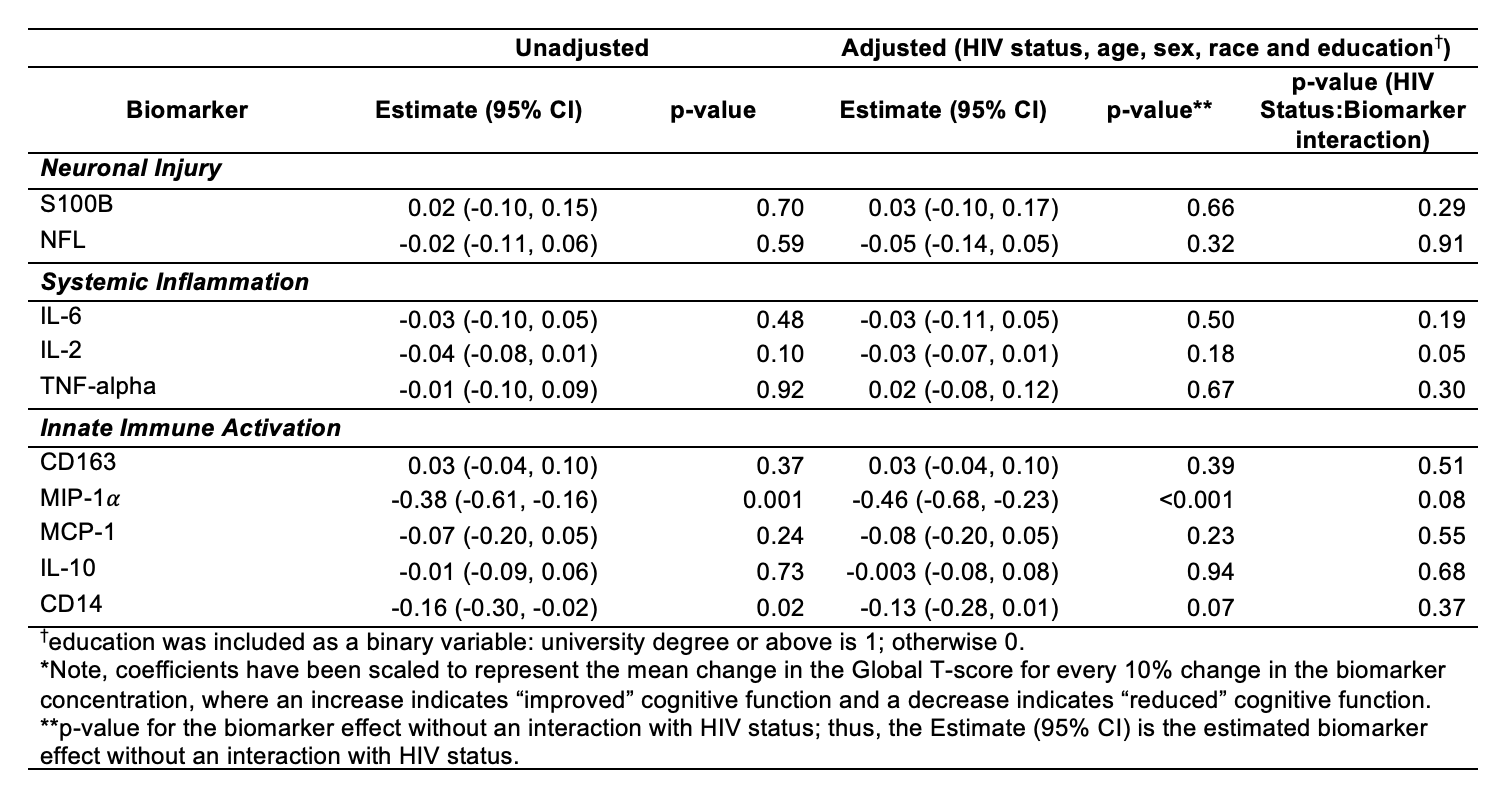
350 participants were included (255 (73%) PWH, median [interquartile range, IQR] age 54 [50-60] years, 85% male, 94% white, and 77% men having sex with men). Among PWH, most (98%) were on antiretroviral therapy, 236 (93%) had HIV-RNA ≤50 copies/mL and median [IQR] CD4+ T-cell count was 629 [490, 794] cells/mm3. Mean (standard deviation (SD)) baseline Global T-score was 47.7 (5.9); after median [IQR] follow-up time of 26 [24-29] months, mean (SD) Global T-score was 48.9 (5.5) (p-value for within-individual change < .001). A reduction in CF (i.e. decline in Global T-scores) was associated with higher concentrations of MIP-1α (estimated mean change in Global T-scores: -0.38 [95% confidence interval: -0.61, -0.16] for a 10% increase in biomarker concentration) and CD14 (-0.16 [-0.30, -0.02]), though only MIP-1α (-0.46 [-0.68, -0.23]) remained significant after adjustment. There was some evidence that the effects of MIP-1α (p-interaction=.08) and IL-2 (p-interaction=.05) were stronger in PWH (Table).
Conclusions:
Within an extensive panel of plasma biomarkers, we observed negative associations with plasma MIP-1α, CD14 and IL-2 suggesting innate immune activation and systemic inflammation may both be implicated in the pathogenesis of CF changes and these effects may differ in PWH.
Table. Results of unadjusted and adjusted linear regression analyses testing associations between changes in Global T-scores (outcome: change scores) and log-transformed biomarkers, Estimate* (95% confidence interval (CI))