Background:
Relationships between immune measures and neurocognition in persons with HIV (PWH) on ART are unclear.
Methods:
We analyzed data, including nadir and current CD4 cells/μl (CD4), CD4%, and CD4:CD8 ratios, from virally suppressed PWH (HIV RNA <200 copies/ml >75% of time since ART start) with >2 NPZ3 scores in ALLRT (ACTG 5001) and HAILO (ACTG 5322). We used longitudinal linear mixed models with fixed and random effects to assess associations between NPZ3 (measured ≥96 weeks post ART start, baseline) and immune measures. We adjusted models for age, sex, and race/ethnicity, with and without adjustment for HIV RNA (>200 vs ≤200 copies/ml), type and years of ART use, and HCV infection.
Results:
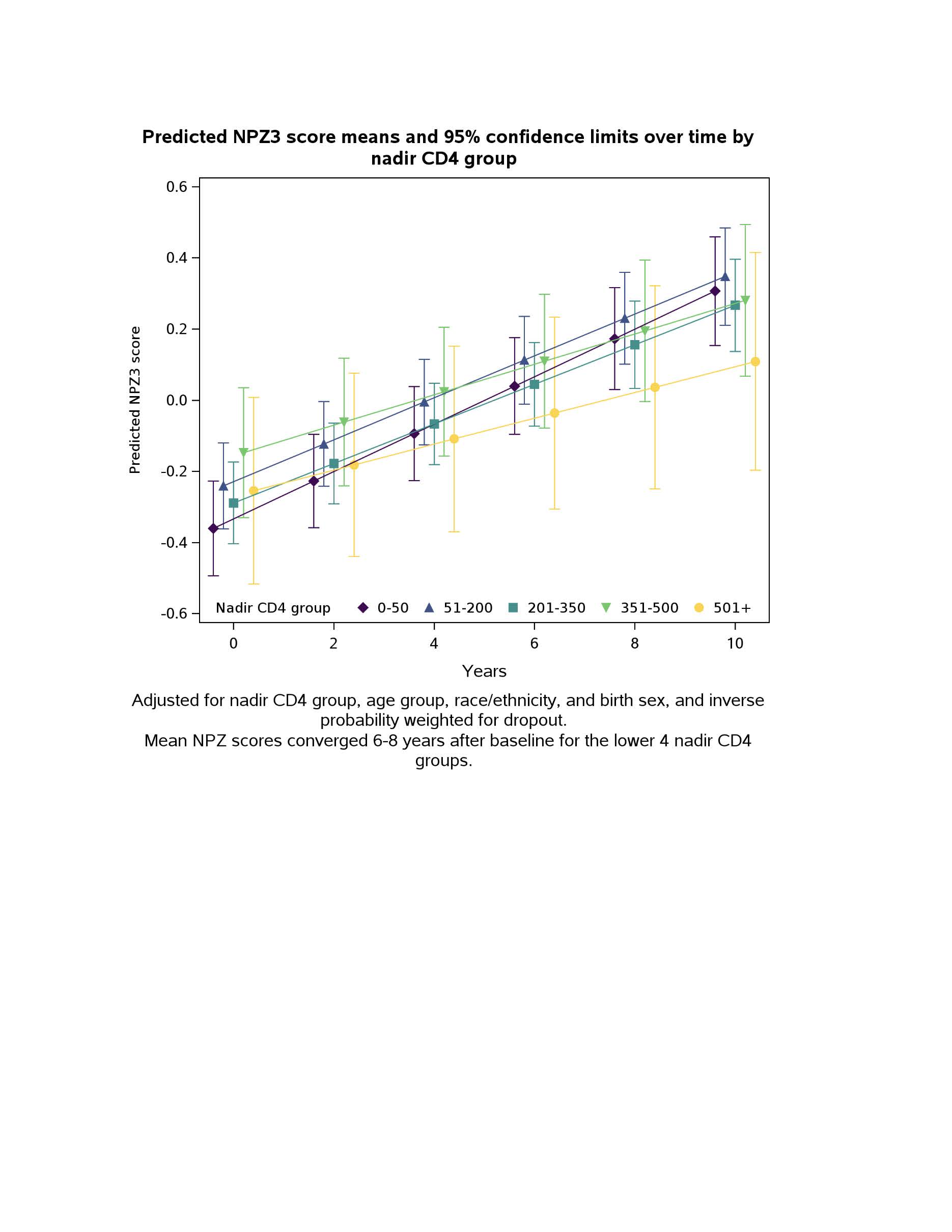
Among 885 PWH seen 1/1/2000-12/30/2021, median (Q1, Q3) age at ART start was 44 (39, 48) years, 81% were male, 50% were White, 29% Black, 21% Hispanic or other. CD4 nadir was 0-50 (22%), 51-200 (29%), 201-350 (33%), 351-500 (11%), 501+(5%). Baseline median CD4 was 486, CD4:CD8 0.66 and NPZ3 score -0.10 (Q1, Q3)(-0.70, 0.53). Higher nadir CD4 was associated with higher baseline NPZ3 but slower NPZ3 increase: PWH with nadir CD4 0-50 had mean NPZ3 increases of 0.067 per year (95% CL = (0.056, 0.077); PWH with nadir CD4>501 had smaller increases (0.030 fewer points) per year (95% CL=(-0.054, -0.007)). Adding any time-updated CD4 measure attenuated nadir CD4 associations with NPZ3, often rendering them non-significant. A standard deviation (1SD) (309 cells/µl) increase in maximum CD4 was associated with an increase in NPZ3 score of 0.034 (95% CL=-0.011, 0.080), and a reduction in NPZ3 score slope of -0.007 (-0.013, -0.002). A 1SD (10.4) increase in CD4% was associated with a 0.074 (0.034, 0.113) increase in NPZ3 score and a decrease of -0.009 (-0.015, -0.004) in NPZ3 slope. A 1SD (0.527) increase in CD4:CD8 ratio was associated with an increase in NPZ3 score 0.060 (0.020, 0.099) and reduction in NPZ3 score slope of -0.007 (-0.012, -0.001). When nadir and current CD4 were modeled together, their effects were not statistically significant. Effects were similar in fully-adjusted models; current CD4% and CD4:CD8 remained most strongly associated with current NPZ3 score and change over time; NPZ scores converged at 6-8 years after baseline for the lower 4 nadir CD4 groups.
Conclusions:
Lower nadir CD4 was associated with lower NPZ3 score at baseline but greater increases over time. Current CD4% and CD4:CD8, but not absolute CD4, had the strongest associations with current NPZ3 score and change over time.