Background:
Anemia continues to be an independent predictor of mortality in the ART era, but few analyses have focused on this association. If we are to intervene on anemia, we need to understand it more fully. We estimate the association between anemia and anemia severity with mortality following the initiation of ART among PWH in North America.
Methods:
Within the NA-ACCORD, median hemoglobin measurements each year between 01/01/2007-12/31/2016 were categorized into mild (11.0-12.9g/dL men, 11.0-11.9g/dL women), moderate (8.0–10.9g/dL regardless of sex) and severe (< 8.0g/dL regardless of sex) anemia. Discrete time-to-event analyses and complementary log-log link models estimated crude and adjusted mortality hazards ratios (aHR) and 95% confidence intervals for the association between anemia and anemia severity with mortality. Models were adjusted for race/ethnicity, HIV risk, year, age, hepatitis B and C virus, hypertension, diabetes, chronic kidney disease, non-AIDS defining cancer, clinical AIDS diagnosis) median viral load, median CD4 count, and ART use the year of hemoglobin observation. Subgroup analyses were conducted stratified by sex. The change in median hemoglobin was assessed yearly looking back from the year of death or censoring.
Results:
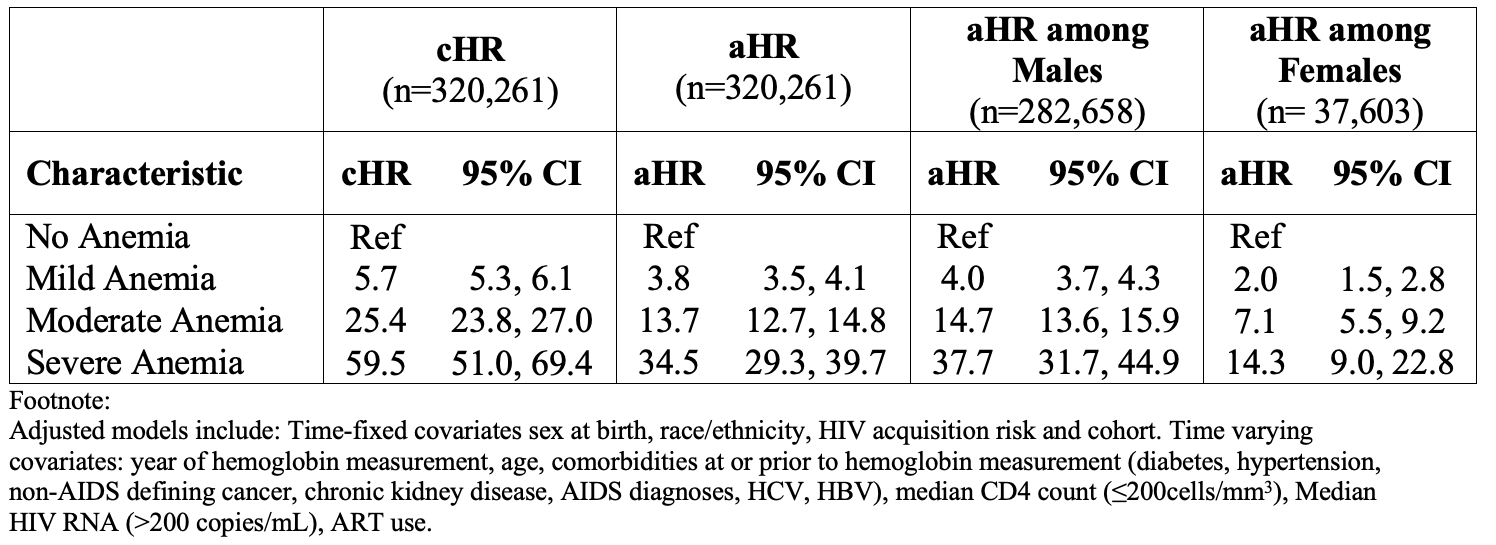
Among 67,228 PWH contributing 320,261 annual median hemoglobin observations, 257,293 (80%) were not anemic, 44,041 (14%) had mild, 18,259 (6%) moderate, and 668 (0.2%) severe anemia. Among females 31% of median hemoglobin measures were categorized as anemic with 18% in male PWH. Average follow-up time was similar in those with anemia and without anemia (3.63 years vs. 3.74 years, respectively). The risk of death was 6.4 times higher among PWH with (vs. without) anemia (95% CI 6.0, 6.8); the magnitude of association was greater among males (aHR=6.6 [6.1, 7.1]) than females (aHR=4.5 [3.6, 5.7]). The strength of the association between anemia and mortality increased with greater anemia severity (compared to no anemia) among males and females (Table 1). We noted 3 years prior to death a decline in median hemoglobin levels, with the most dramatic decrease by 0.6 g/dL within the year prior to death.
Conclusions:
Anemia among PWH who have initiated ART remains a significant risk factor for death with increasing risk as anemia severity worsens and among males. Anemia is an important predictive marker for mortality among PWH and identification of anemia among PWH should prompt further investigation into the underlying cause.
Table 1: Crude (cHR) and adjusted (aHR) mortality hazards ratios for the association between anemia severity with mortality among people with HIV in the NA-ACCORD and stratified by sex.