While associations between use of older antiretroviral drug (ARV) classes and CVD are well described, there are limited data related to use of INSTIs.
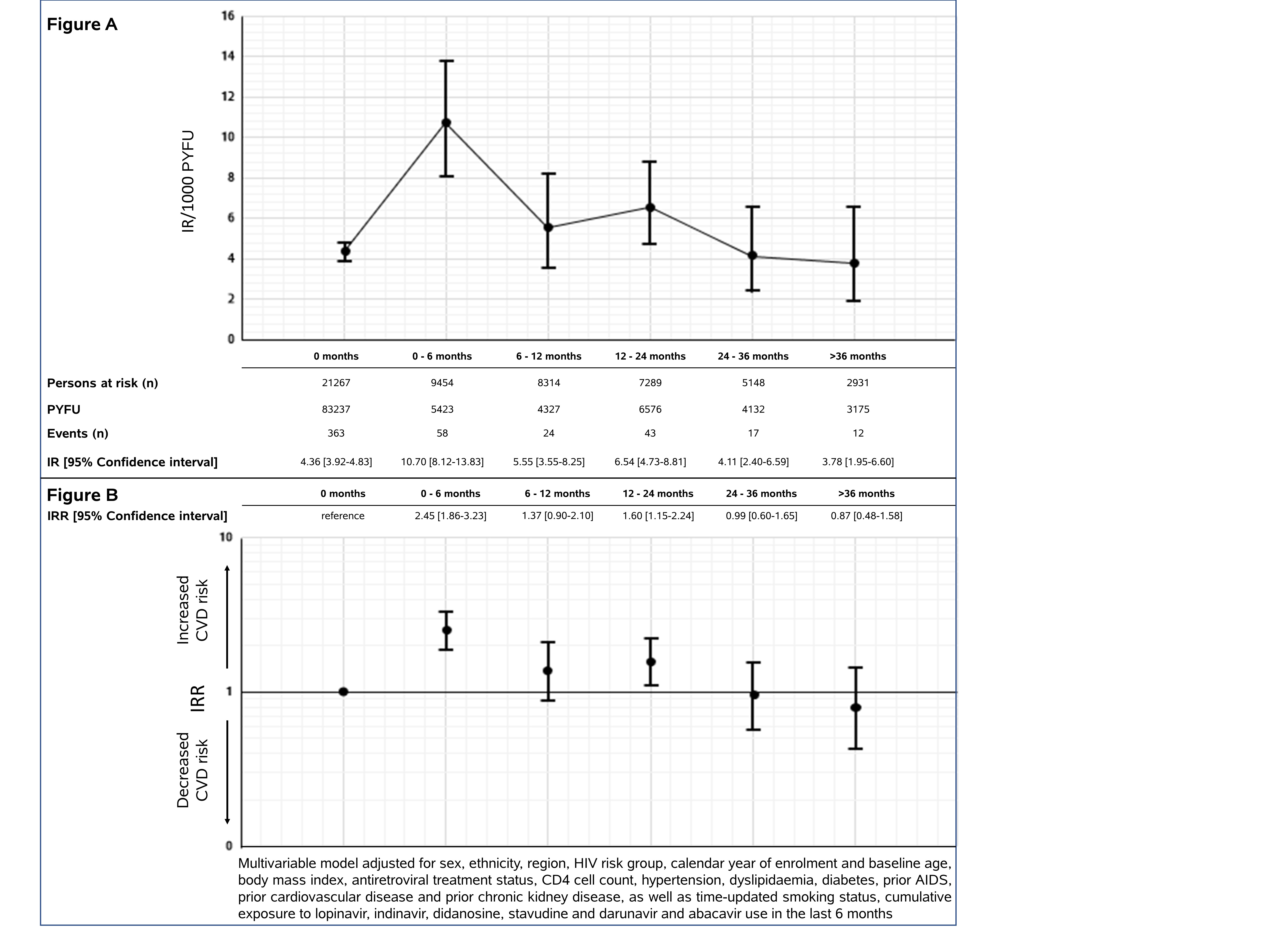
RESPOND participants were followed from latest of cohort enrolment or 1. Jan. 2012 (baseline) to the earliest of first CVD event (myocardial infarction [MI], stroke or invasive cardiovascular procedure [ICP]), last follow-up (FU) or 1. Oct. 2018. Logistic regression tested associations between 10-year D:A:D CVD risk score and starting an INSTI. To assess associations between CVD and INSTI exposure, multivariable negative binomial regression models were adjusted for demographics, traditional CVD risk factors, HIV-related factors, antiretroviral treatment (ART) status and concomitant or prior use of ARVs associated with CVD; where appropriate, variables were time-updated (figure footnote).
Of 21267 included individuals, 46% were exposed to one or more INSTIs during FU (2147 to raltegravir, 2385 to elvitegravir and 6372 to dolutegravir). Compared to low baseline D:A:D CVD risk, odds of starting an INSTI were higher for those with a medium and high risk (odds ratio, 95% confidence interval, CI; 1.1 [1.0-1.2] and 1.2 [1.1-1.4]), though not reaching significance for those with a very high risk (1.1 [0.9-1.2]). During a median 6.3 years of FU (interquartile range 3.5-6.7; 106,870 person-years, PYFU), 517 individuals experienced a CVD event (incidence rate, IR, 4.9/1000 PYFU [4.5-5.3]: 210 MIs, 162 strokes, 145 ICPs;). The crude CVD IR increased from 4.5/1000 PYFU [3.9-4.8] in those with no INSTI exposure to 10.7/1000 PYFU [8.1-13.8] at >0-6 months and decreased steadily thereafter (Figure). After adjustment, compared to those never exposed, the IR ratios of CVD peaked at >0-6 months of INSTI exposure (2.5 [1.9-3.4]) but were comparable to those unexposed thereafter (p <0.01, Figure). Results were consistent in models adjusting only for D:A:D CVD risk score, and models excluding ICP events or individuals with prior CVD. There was no interaction between INSTI exposure group and age (p=0.3) or D:A:D CVD risk strata (P=0.6)
In the large RESPOND collaboration use of INSTIs was associated with an increased incidence of CVD in the first 6 months of exposure after accounting for known CVD risk factors including the ART backbone and across a wide range of sensitivity analyses. While we cannot fully exclude possible channeling bias or residual confounding, these findings call for further investigations.