Background:
People with HIV (PWH) are at an increased risk of head and neck cancer (HNC) compared with people without HIV (PWoH). However, little is known regarding the impact of HIV on HNC survival. This study is one of the first to compare survival, by histological subtype of HNC, between PWH and PWoH.
Methods:
A retrospective cohort of adults with newly diagnosed 1)oropharyngeal, 2)non-oropharyngeal (hypopharynx and larynx), 3)oral cavity cancers was identified using electronic health record data from the National Veterans Administration and Kaiser Permanente California regions from 2008 to 2020. Separate Cox regression models were used to assess the association of HIV infection with overall survival (OS) for each cancer type, adjusting for baseline sociodemographic factors, clinical characteristics, and HPV+ tumor status (oropharyngeal only). Multiple imputation was used for missing covariate data.
Results:
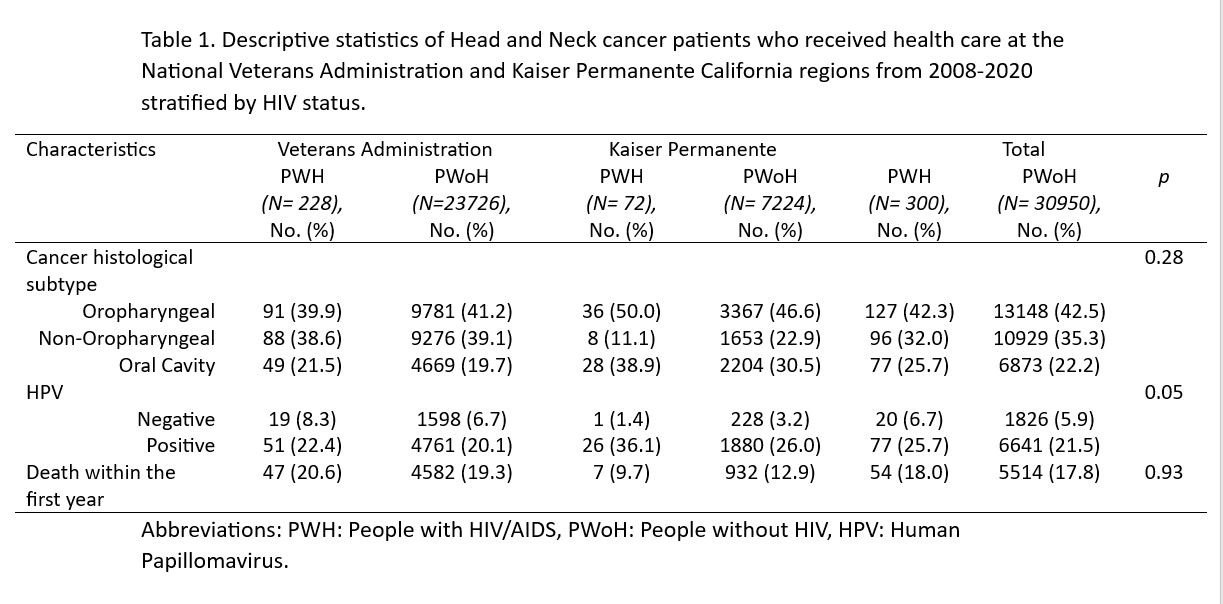
Our analysis included 300 PWH and 30,950 PWoH HNC patients. Compared with PWoH, PWH were more likely to be younger; male; Black or Hispanic; had lower education attainment and income levels; and have co-infection with HPV, HBC, or HCV. Mortality rates for PWH vs. PWoH were 13.0 vs.9.7 per 100 person-years for oropharyngeal; 7.3 vs.13.0 for oral cavity; and 12.0 vs.14.0 for non-oropharyngeal cancers. In unadjusted analysis, HIV infection was associated with worse OS for oropharyngeal cancer (hazard ratio [HR]:1.31, 95%CI:1.02-1.66); better OS for oral cavity cancer (HR:0.57, 95%CI:0.39-0.82); and similar OS for non-oropharyngeal cancers (HR:0.83,95%CI:0.63-1.10). In adjusted analysis, similar trends were observed with worse OS in oropharyngeal cancer patients (HR:1.38, 95%CI:1.08-1.77); better OS in oral cavity cancer (HR: 0.66, 95%CI:0.46-0.96); and similar OS for non-oropharyngeal cancer (HR:0.94, 95%CI: 0.71-1.25). However, for oropharyngeal cancers, patients with HPV+ tumors had better survival compared with patients with HPV-negative tumors (HR: 0.50, 95%CI: 0.47-0.53). Other risk factors for poor OS for HNCs included older age at cancer diagnosis, early year of cancer diagnosis, higher stage of cancer, higher Charlson comorbidity index, alcohol abuse diagnosis, and ever smoking.
Conclusions:
The study results suggest that PWH had poor survival for oropharyngeal cancer but better survival for oral cavity cancers compared with PWoH. Further research should focus on finding the etiological factors influencing HIV’s role in outcomes related to HNCs.