Background:
People who inject drugs (PWID) experience high risk of both HIV and hepatitis C (HCV) but face barriers to testing and engagement in care. Assisted partner services (APS) is effective at case finding for HIV but has been understudied among PWID. We determined whether APS could find, test for HIV and HCV, and link to care the sexual and injection partners of PWID living with HIV in Kenya.
Methods:
We conducted a prospective study in 8 sites in Kenya. Index participants—people living with HIV (PLHIV) actively injecting drugs– were interviewed and provided locator information about sexual and injection partners. Peer educators located partners and brought them to study sites, where partners completed questionnaires and rapid HIV testing. All participants also had rapid HCV antibody testing and all participants positive for HIV or HCV antibodies underwent a blood draw for viral load testing. Intimate partner violence (IPV) was monitored for all participants at moderate or high risk. Data were entered into REDCap and analyzed using Stata. Numbers needed to interview (NNTI) to find partners in need of care were calculated.
Results:
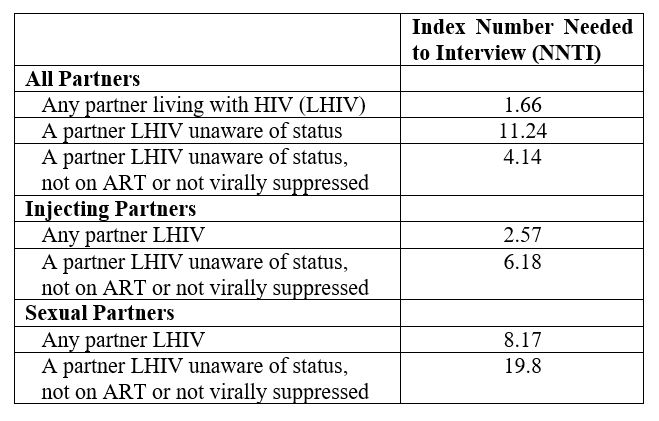
989 index participants mentioned 4705 partners and 4588 (97%) of mentioned partners were located, of whom 18.0% were living with HIV and 11.8% were HCV antibody-positive. Of the 597 living with HIV, 85.2% already knew their status, of whom 91.3% reported currently taking ART and 77% were virally suppressed. NNTIs are shown in Table 1. Of 393 partners positive for HCV antibodies, 53.7% were viremic, 26.5% already knew their antibody status, and 1% had previously been treated. Prevalence of both HIV and HCV differed by partner type. 6-month follow-up completion was 86%. Over 70% of index participants and partners who were not on antiretroviral therapy at enrollment were taking it at 6-month follow-up visits. No IPV or adverse events, including violence or death, occurred due to study procedures.
Conclusions:
When used among PWID, APS for PLHIV is safe and effectively identifies partners living with both HIV and HCV. Although many partners were already aware of their HIV status, APS also increased engagement in care for both index participants and partners over a 6-month period.
Table 1. Numbers of index participants interviewed to find partners in different categories