Background:
Blood-based markers (BBMs) show promise in evaluations of Alzheimer’s disease and other cognitive disorders. We examined plasma neurofilament light chain (NFL) and glial fibrillary acid protein (GFAP) and their relationship to cognitive function in people with HIV (PWH) enrolled in the ACTG aging cohort study, HAILO.
Methods:
Clinical data and plasma were obtained from 550 PWH aged ≥45y with ≥2 neuropsychological tests (NP) and HIV RNA<200 copies/ml. Four NP scores (Trail Making Test Part A and B, Digit Symbol, and Hopkins Verbal Learning Test-Revised) were standardized as z-scores. The average of these z-scores (NPZ4) at plasma collection or subsequent visits were provided by HAILO and used as primary outcomes; longitudinal scores were summarized by calculating the slope for each participant. We used a single molecule array platform to quantify NFL and GFAP. Associations between BBMs and baseline NPZ4 scores or slopes were assessed with linear regression. Longitudinal analyses were done for the total cohort and a subset with NPZ4 decline (slope <0). Models were adjusted for age, sex at birth, race, and years of education; regressions of slopes were also adjusted for baseline NPZ4 and weighted by number of visits.
Results:
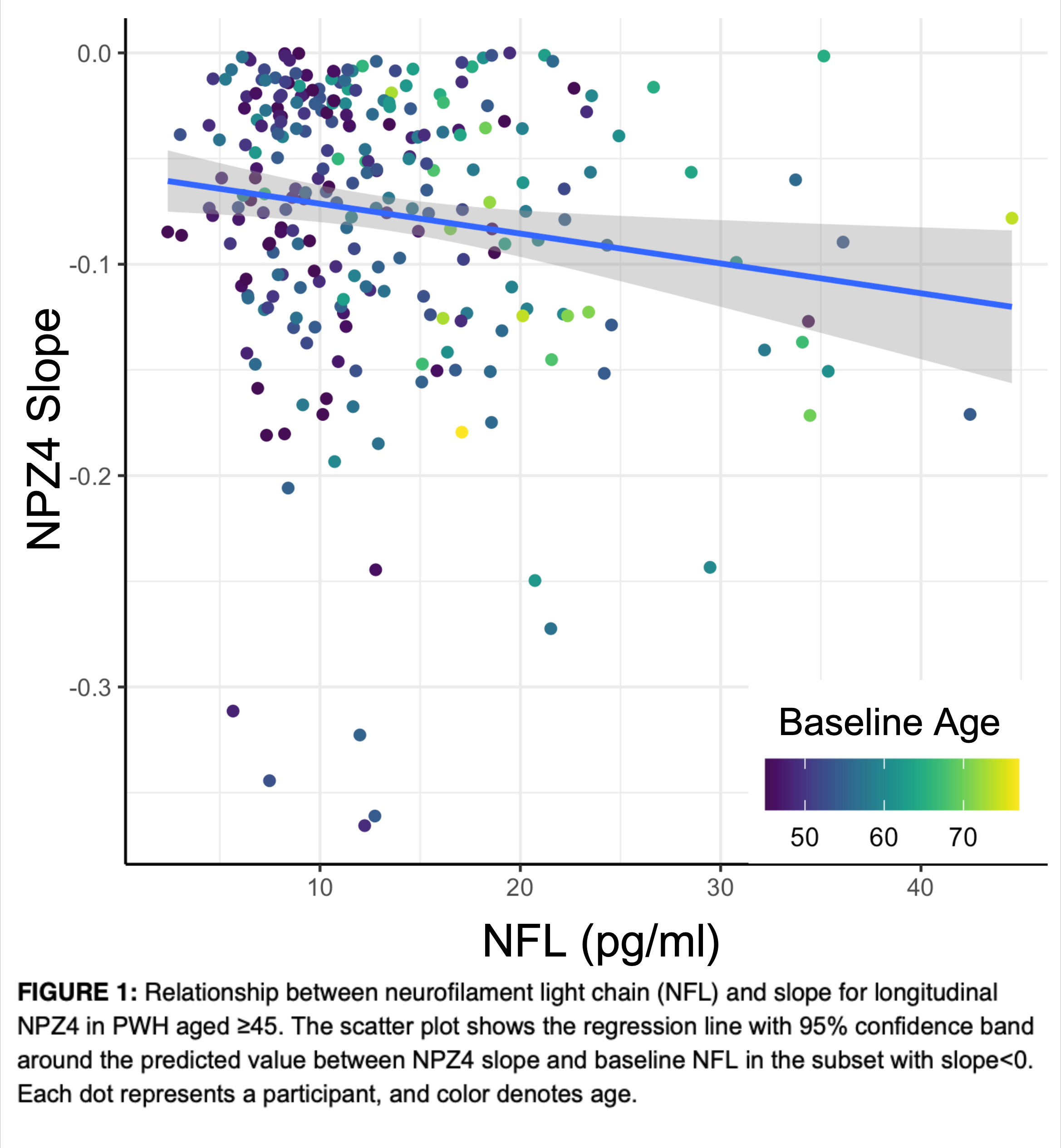
Mean age was 53y (range 45-77y), and observation time was 6.2y, 19.6% were female, and 28.4% non-Hispanic Black. Median [IQR] baseline NFL, GFAP, and NPZ4 scores were 10.7 pg/ml [7.98, 14.62], 77.5 pg/ml [58.80, 107.86], and 0.11 [-0.48, 0.75], respectively; median [IQR] NPZ4 slope was 0 [-0.06, 0.06]. In adjusted models, higher NFL or GFAP was associated with worse baseline NPZ4 (-0.05 per 10pg/ml NFL; p=0.06; -0.14 per 100 pg/ml GFAP; p=0.04) and became significant after excluding outliers NFL≥25 (p=0.03) but not GFAP≥200 (p=0.2). While baseline NFL (p=0.11) and GFAP (p=0.053) showed a weak relationship with NPZ4 slope in the total cohort, NFL had a stronger association in the subset with cognitive decline (n=263; -0.02 annual decrease per 10pg/ml NFL, p<0.01; Figure 1). The variance explained was ≤10% in all models.
Conclusions:
In this cohort of PWH, with the majority in mid-life and cognitively stable, NFL and GFAP were associated with a minor decrement in cross-sectional NPZ4, and NFL was weakly associated with longitudinal NPZ4. NFL more strongly predicted NPZ4 slope in a prespecified subset with cognitive decline. Overall, results highlight the limitations of NFL and GFAP as predictive biomarkers of cognitive decline in this age range.