Non-alcoholic fatty liver disease (NAFLD) is becoming a serious complication for people living with HIV (PLWH). With validation of transient elastography (TE) and controlled attenuation parameter (CAP) as non-invasive tools in contrast to biopsies, diagnosing liver fibrosis and hepatic steatosis (HS) had become much easier. Quite recently the FibroScan-AST (FAST) score had been validated in HIV negative individuals with suspected NAFLD as an efficient tool to identify those at risk of progression to NASH. To date the FAST score had not been reported in HIV monoinfected individuals (HIV+).
We enrolled 432 HIV positive patients presenting at our outpatient clinic between August 2013 to December 2018. Liver stiffness and HS were assessed yearly by TE using an M-probe of FibroScan (Echosens, Paris, France). FAST Score was calculated retrospectively according to Newsome et al. for each year and compared to other markers of liver disease.
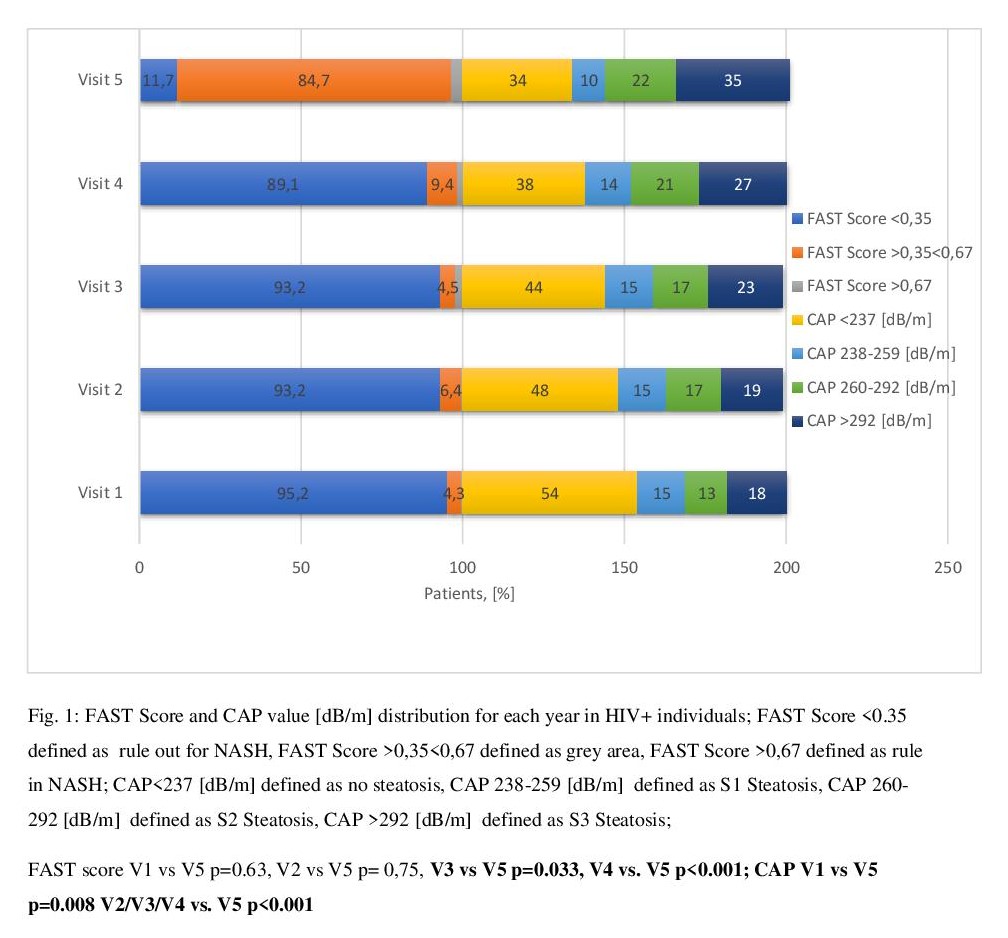
Overall, 303 HIV+ patients (79% male, average age at baseline 45.9+11.5 years, average duration of infection 9.3±6.4 years) with at least two visits were analysed. All patients were administered ART. FAST score was available for 187, 236, 222, 192 and 111 patients at visit V1, V2, V3, V4 and V5, respectively. Distribution of FAST Score and CAP values are shown in Fig. 1. FAST score at baseline showed a strong correlation with baseline FIB4 scores (R: 0,740; p<0.001) and APRI scores (R: 0,514; p<0.001) but was weaker with CAP values (R: 0,385; p<0.001). In contrast to HIV specific parameters (baseline viral suppression, nadir CD4 count <200/µl), male sex, ever being treated with an INSTI and a baseline BMI >25kg/m² as well as Diabetes mellitus type 2 (DM2) were associated with higher FAST scores.
This is the first report on FAST Score in HIV+ persons. We found a significant correlation with FIB4, APRI and CAP values. In contrast to an observed steady redistribution towards higher CAP values (reflecting an increase in steatosis) over five years, the FAST score remained nearly unchanged in its distribution until there was a sudden increase towards a so far not well defined ‘grey area’ of progressive NAFLD after four years of observation. Possible risk factors in univariable analyses for higher FAST scores were male sex, overweight, DM2 and certain antiretroviral drugs. Due to the rapid, inexpensive and non-invasive assessment of the FAST score, it should be further investigated in PLWH.