Background:
A proportion of HIV-infected persons on antiretroviral therapy [ART] have detectable viral loads [VL] at low levels without ever meeting criteria for virologic failure [VF]. The clinical consequences of this low-level viremia [LLV] are not well understood. In this study we examined the association between detectable VL and serious non-AIDS events (SNAEs)
Methods:
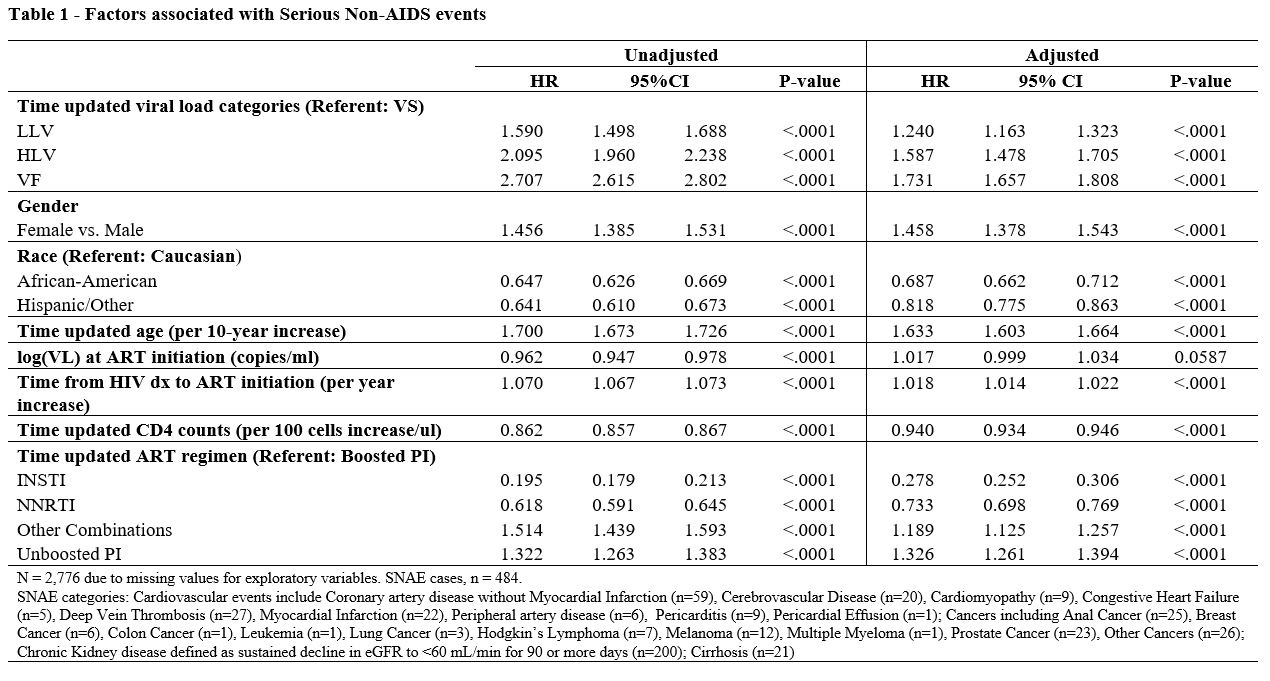
We used data from the US Military HIV Natural History Study (NHS). The NHS is comprised of military beneficiaries who are enrolled early in infection and have access to care and medications. NHS participants who initiated ART after 1996 were included if they had two or more VLs measured using an assay with a lower limit of detection of <50 copies/mL, ≥ 6 months after ART initiation. VLs were categorized as LLV [51-199 copies/mL], high level viremia [HLV- 200-999 copies/mL], VF [≥200 copies/mL on 2 or more successive determinations or a single VL≥1000 copies/mL] and virologic suppression [VS- ≤50 copies/mL on all determinations and blips]. SNAEs evaluated are footnoted on table 1. We examined the first occurrence of a SNAE from any category. Factors significant at a p < 0.05 in the univariate model were included in the multivariable Cox proportional hazards models. We adjusted for gender, race, time to ART start; Age, VL category, ART regimen and CD4 count were analyzed as time updated variables.
Results:
2814 participants [94% male, 40% Caucasian, 43% African American] were followed for a median of 10.1 years [IQR 4.8 to 18.2]. A total of 490 [17.4%] SNAEs were recorded {107 [3.8%] malignancies, 158 [5.6%] cardiovascular events, 204 [7.25%] cases of chronic kidney disease and 21 [0.8%] cases of cirrhosis}. A third of the participants had one or more episodes of VF, LLV was noted in 16% and HLV in 7.4 %. We observed an association with LLV, HLV, VF and SNAEs with a graded hazard by level of viremia, table 1. Other factors associated with SNAEs were older age, female gender, Caucasian race, delays in ART initiation and regimen type. In comparison with boosted PI, InSTIs and NNRTIs were protective, whereas unboosted PI use had a greater risk. Higher CD4 counts were protective.
Conclusions:
The results of this study add to a growing body of literature that suggest detectable viremia including LLV could have adverse clinical consequences. We confirm previously observed negative clinical consequences of delays in ART initiation and lower CD4 counts. The association with race gender and ART categories, need further evaluation.
Table 1- Factors associated with Serious Non-AIDS Events in the NHS