Background:
Viral blips may represent bursts of HIV replication or clonal expansion from reservoirs. Antiretroviral therapy (ART) started within days of HIV acquisition may limit reservoirs, thereby decreasing blips, but is uncommon. We evaluated the impact of ART initiation within months to years after HIV acquisition on the occurrence of viral blips.
Methods:
The ongoing U.S. Military HIV Natural History Study enrolls adult U.S. Department of Defense beneficiaries with HIV. HIV RNA results and ART medications are extracted from centralized electronic medical records. These analyses included participants who had an estimated HIV seroconversion date (midpoint of documented negative and positive test dates), achieved viral suppression (VS) ≤400 copies/mL within 1 year after starting ART, and had at least 3 HIV RNA measurements after achieving VS. A blip was any HIV RNA 401-1000 copies/mL immediately preceded and followed by HIV RNA ≤400 copies/mL without a change in ART. Cox proportional hazards models were used to estimate hazard ratios (HRs) and 95% confidence intervals (CIs) for factors potentially associated with the time from VS to first viral blip.
Results:
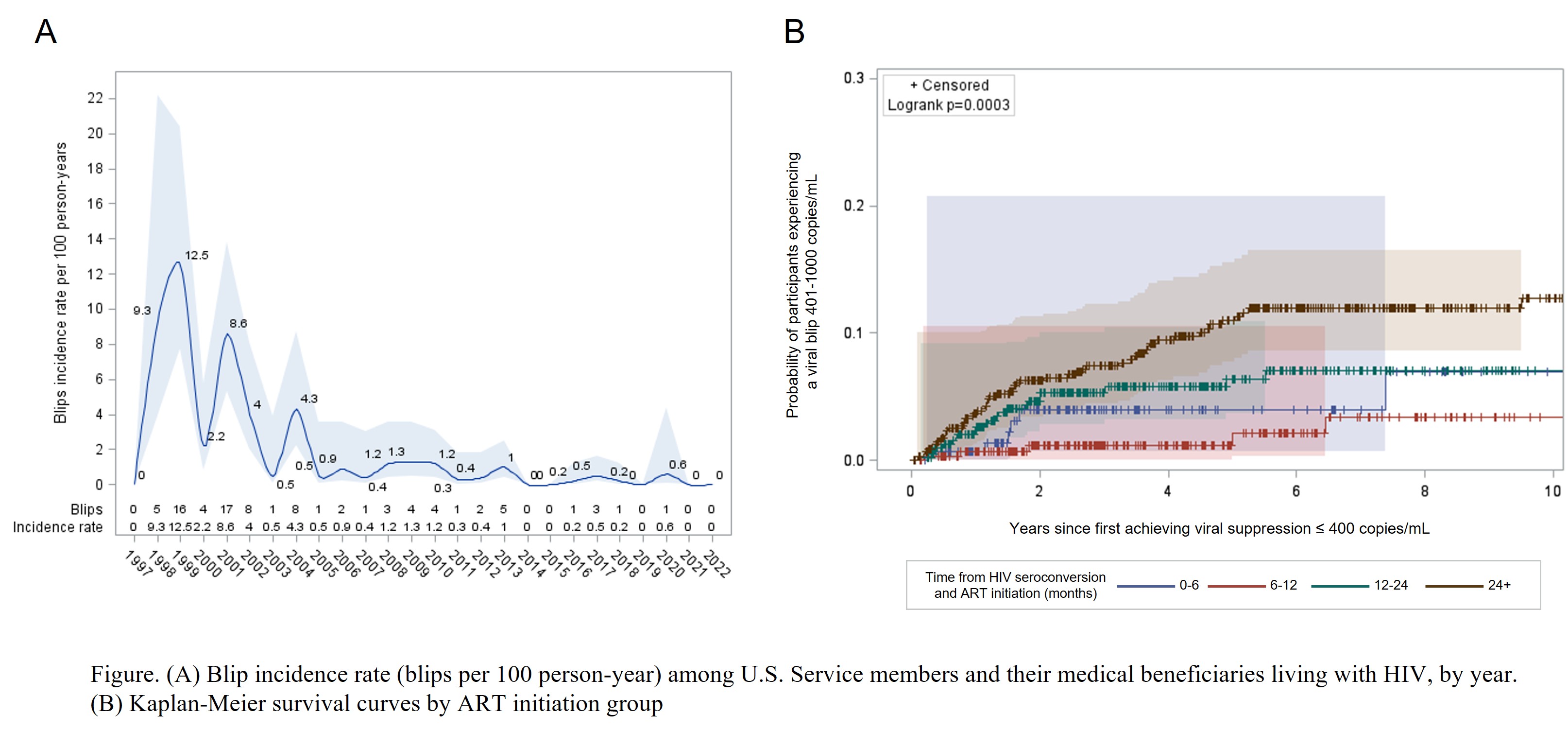
From January 1996 to December 2022, 1,413 participants on suppressive ART met inclusion criteria for these analyses. Their median age at HIV diagnosis was 29.2 years (interquartile range 24.9-35.4) and a majority were males (96.3%). Viral blips were observed in 88 (6.2%) participants. Of these, 68 (77.3%) had a single blip, 13 (14.8%) had two blips, four (4.5%) had three blips, and three (3.4%) had four blips. The overall incidence of blips was 1.2 blips per 100 person-years (95% CI 0.9-1.4) and blip incidence decreased over time (Panel A). ART initiation within 24 months of estimated HIV acquisition was associated with decreased hazard of viral blips as compared to ART initiation after more than 24 months (0-6 months HR 0.32 [95% CI 0.20-0.52]; 6-12 months HR 0.48 [95% CI 0.35-0.67]; 12-24 months HR 0.52 [95% CI 0.40-0.69]; controlling for age, sex, race, time-updated ART regimen, time-updated CD4, HIV RNA at ART initiation, ART adherence [proportion of days covered >90%], history of hepatitis B, and history of hepatitis C; unadjusted in Panel B).
Conclusions:
Participants who initiated ART within two years of HIV acquisition had lower hazard of blips. Further research to characterize the clinical implications of blips and how they relate to HIV reservoir dynamics is ongoing. HIV reservoir plasticity may extend beyond the period of acute HIV.