Background:
It is unknown if antiretroviral therapy (ART) concealment to prevent inadvertent disclosure of one’s HIV status impacts ART adherence. Our aims are to describe ART concealment behaviors and associated factors among a cohort of PWH and assess whether ART concealment is associated with ART adherence or interest in long-acting injectable (LAI) ART.
Methods:
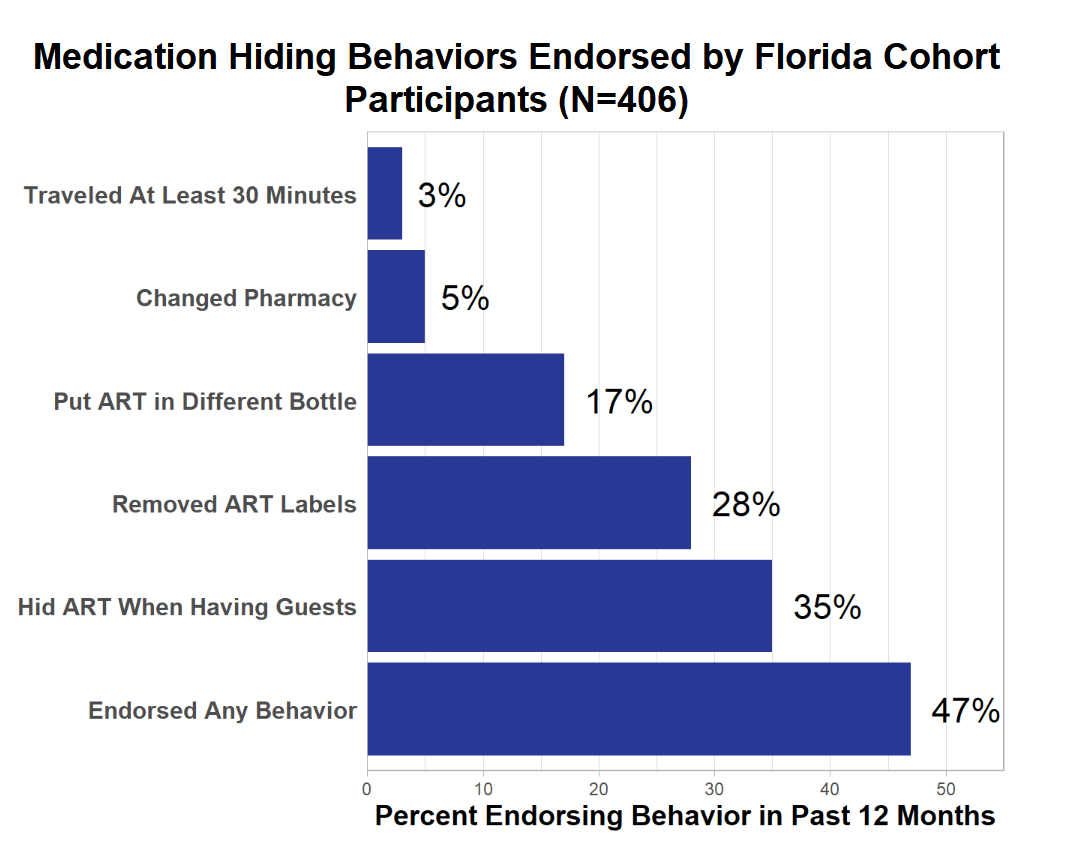
The Florida Cohort Study has been enrolling adult PWH around the state since October 2020. Participants were asked about ART adherence (optimal ≥85%) in the preceding 30 days, engagement in at least one of five ART concealment behaviors to hide their HIV status in the past year (hiding ART bottles, removing prescription labels, moving ART to another bottle, changing their pharmacy, and traveling ≥30 miles to obtain ART), and preferences for ART formulations (strong preference for LAI or not). Disclosure of HIV status to social network was categorized as having no social network to disclose to, incomplete disclosure of status to social network, and complete disclosure (reference). Simple and, if significant, multivariable (adjusting for age, alcohol use, injection drug use, depression, and anxiety) logistic regression models were used to discern differences between those with and without ART concealment and associations with ART adherence and LAI preference.
Results:
Of 406 participants between 2020-2022 (62% aged 50+, 60% male, 42% non-Hispanic Black), 47% reported at least one ART concealment behavior, 6% reported < 85% adherence, and 64% of the 308 participants who responded preferred LAI. ART concealment was associated with at-risk drinking (aOR 2.5 95% CI 1.4, 4.6), depression symptoms (aOR 2.2 95% CI 1.1, 4.2), incomplete disclosure to their close social network (aOR 3.1 95% CI 1.9, 5.0) or reporting not having a social network (aOR 3.3 95% CI 1.4, 7.8), and ≥85% ART adherence (aOR 0.3 95% CI 0.1, 0.9). ART concealment was not significantly associated with LAI preference in simple regression (OR 1.3 95% CI 0.8, 2.3).
Conclusions:
Concealing ART to hide one’s HIV status was common and was associated with at-risk drinking, depression, incomplete disclosure to or lack of close social network, and reduced likelihood of optimal adherence. These findings show PWH may prefer receiving ART through mechanisms that ensure privacy. Future research can examine the impact of ART concealment on HIV outcomes like viral suppression and improve adherence among PWH concerned with disclosure of their HIV status.
Medication Hiding Behaviors Endorsed by Florida Cohort Participants (Nf406)