Background:
Women in Africa disproportionately acquire HIV-1. Understanding which women are most likely to acquire HIV-1 can guide focused prevention, including promotion of pre-exposure prophylaxis (PrEP). We used machine learning to develop a risk assessment tool to identify women most likely to acquire HIV-1 across African countries and to estimate HIV-1 infections averted with focused PrEP.
Methods:
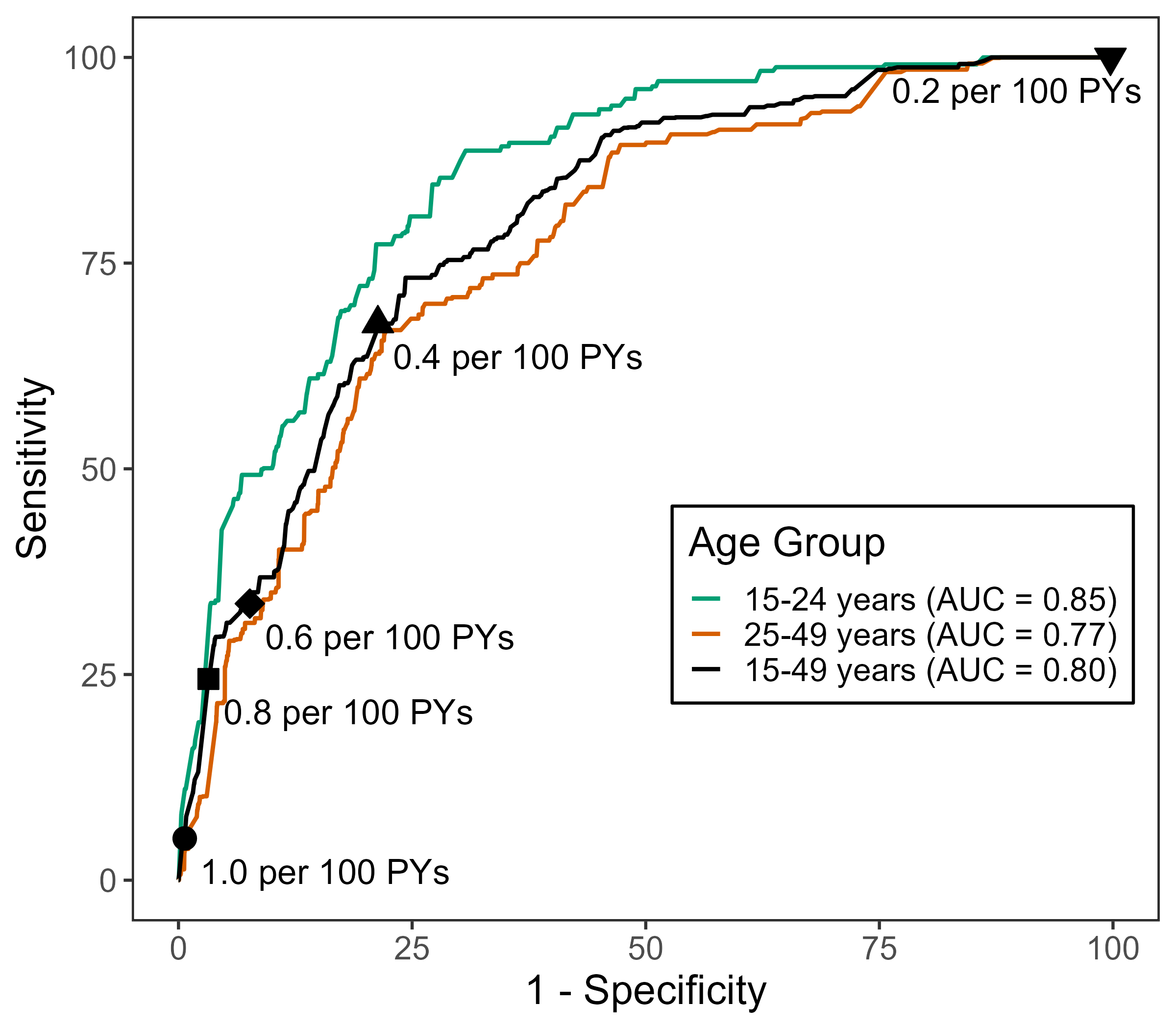
Nationally representative data were collected from 2015-2019 from 15 population-based household surveys. This analysis included women aged 15-49 years who tested HIV-1 sero-negative or had recent HIV-1, characterized by HIV limiting antigen avidity enzyme immunoassay, HIV-1 viral load, and detection of antiretroviral drugs in their survey blood samples. Least absolute shrinkage and selection operator regression models were fit with 28 variables to predict recent HIV-1. Models were trained on the full population and internally validated using five-fold cross validation. Performance was evaluated using area under the receiver-operating-characteristic curve (AUC). Sensitivity, specificity, and potential cases averted were estimated, assuming perfect PrEP adherence among all women at key HIV-incidence thresholds.
Results:
Among 209,012 participants 248 had recent HIV-1 infection, representing 118 million women and 402,000 (95% CI: 309,000-495,000) new annual infections. Only two variables were retained: living in a subnational area with high HIV-1 viremia prevalence and having a sexual partner living outside the home. Overall AUC was 0·80 (95% CI: 0·76-0·84); cross-validated AUC was 0·79 (95% CI: 0·74-0·84). At one key HIV-1 incidence threshold (0.4 per 100 person-years), sensitivity was 67.7% and specificity was 78%. If the 26.1 million women at highest risk for HIV-1 perfectly adhered to PrEP, up to 264,000 cases could be averted.
Conclusions:
HIV-1 acquisition is not evenly distributed, with two thirds of infections occurring among a small fraction of women. This predictive, generalizable, and parsimonious tool has the potential to guide high-impact PrEP delivery.