Background:
Reproductive aging in women with HIV (WWH) introduces significant therapeutic challenges due to the progressive decline in blood levels of estrogen, a known negative regulator of HIV transcription. Our group recently described how the inducible HIV RNA reservoir, as measured by the EDITS assay, increased progressively in women during reproductive aging (PMID: 34612493). Here, we explore possible underlying mechanisms with detailed studies at a single-cell level, which will account for the heterogeneity of the immune cell populations.
Methods:
We selected biorepository samples carefully staged across reproductive stages from cisgender women with HIV from the Chicago Women’s Interagency HIV Study (WIHS). Specifically, we first selected cross-sectional samples from eight WWH, four pre- and four postmenopausal. To account for donor variability, we further selected 3 longitudinal samples (pre-, peri-, and postmenopausal) from 2 WWHs. Blood samples were collected during a ten-year period during viral suppression. To identify differentially expressed (DE) genes, surface protein markers, and pathway enrichment (PE) along the timeline of aging, we used the BD Rhapsody scRNAseq-ABseq platform. For cell typing, we performed ABseq using 30 antibodies to major diagnostic surface antigens of immune cells.
Results:
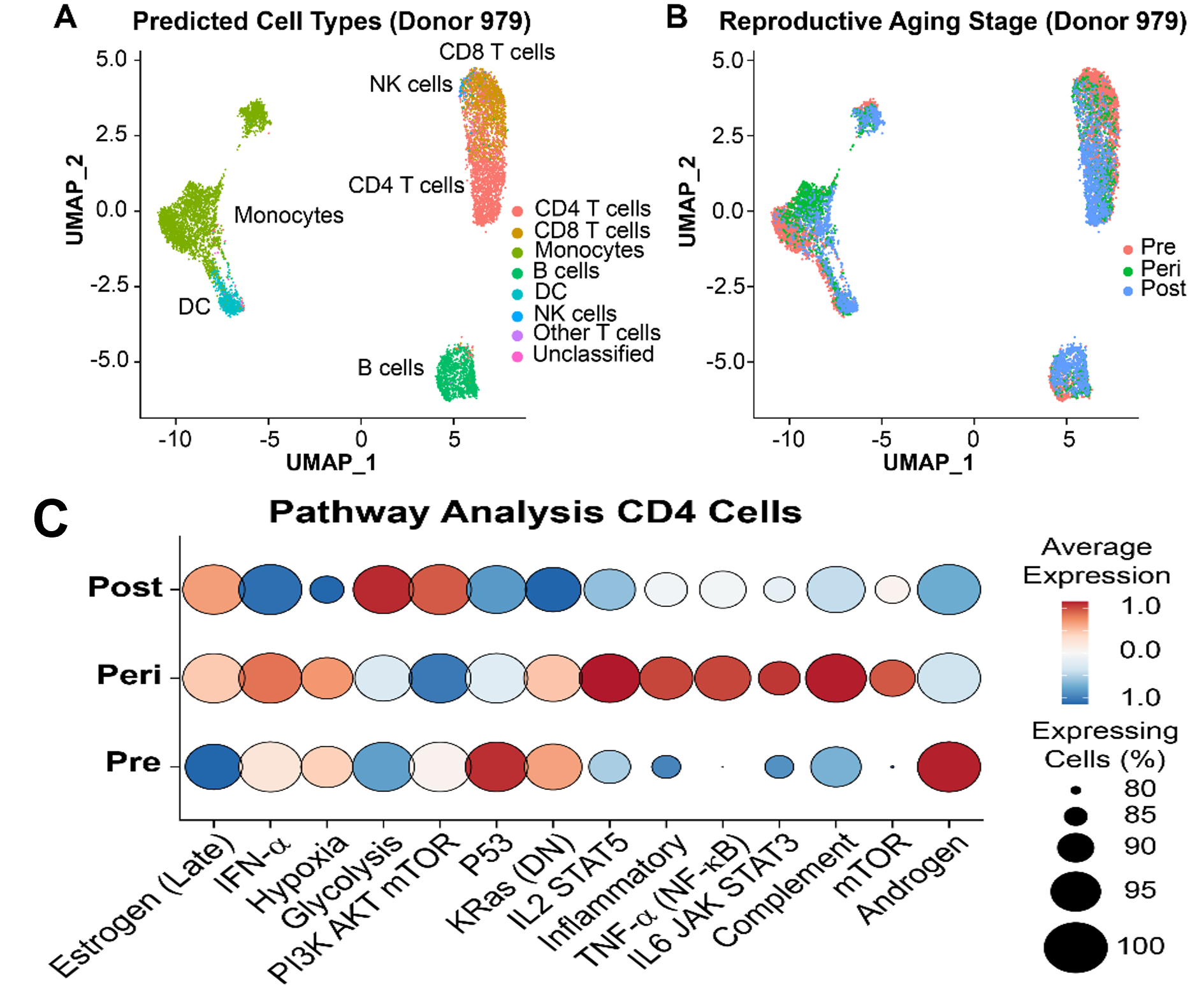
The resulting integrated datasets consisted of >100,000 transcriptome ( >500 genes/cell) and ABseq profiles. We performed detailed DE gene and PE analyses in CD4 and CD8 T-cells, monocytes, NK, DC, and B-cells, and their sub-populations (CD4 Naïve, TCM, TEM, and CTL). The most significant changes were between pre- and perimenopausal participants and less so between peri- and postmenopausal. Thus, TNFα signaling via NFκB, Interferon-α, p53, and complement showed significant enrichment in the cells of perimenopausal participants. Premenopausal CD4 T cells showed enriched PI3K/AKT/MTOR and androgen pathways, whereas genes of the late estrogen response, KRAS signaling, and glycolysis marked the postmenopausal stage (Figure 1). We observed similar DE genes and pathways in cross-sectional and longitudinal datasets.
Conclusions:
Reproductive aging in WWH shifts transcriptome signatures in the immune cells toward innate immune pathways and antiviral cytotoxicity, possibly in response to the rise of inducible HIV reservoir. Future scRNAseq studies including matching males with HIV are necessary to further decipher sex-specific differences.
Figure 1. Immunophenotyping and differential pathway enrichment analysеs in aging WWH by scRNAseq-ABseq. (A) An integrated UMAP plot of pooled single cell scRNAseq/ABseq profiles of total PBMC from donor 979 at pre-, peri- and post- menopause. Cell types were predicted by mapping against the reference PBMC dataset based on cell type-specific gene transcripts and further confirmed by the detection of 30 diagnostic immune cell surface markers using ABseq. (B) UMAP plot of that data from donor 979 highlighting cells obtained from each stage. (C) Dotplot showing pathway enrichment analysis in CD4 T-cells from longitudinal samples collected from three pre-, peri- and postmenopausal participants. Pathways were based on the Molecular Signature Hallmark database. The dot size represents the percentage of cells expressing the pathway-related genes, and the dot color shows log-normalized average expression of each pathway.