Background:
Among ART-suppressed people with HIV (PWH), women have higher levels of several plasma inflammatory markers than men, but the effect of sex on the larger plasma inflammatory proteome, and whether these differences are modified by age, remains unclear.
Methods:
We analyzed 363 unique plasma proteins (Olink Inflammation Explore panel) within a randomly sampled sub-cohort of ART-suppressed (<400 copies HIV RNA/mL) CNICS participants. The relationship between natal sex and plasma proteins was assessed with linear regression models adjusted for age, natal sex, nadir CD4, site, race, MSM status, and clinical factors (smoking, IDU, HCV history, ASCVD risk score). Age-sex interaction terms were also assessed, stratifying age above and below the median age of 47, which in prior studies has approximated the average age of menopause in women with HIV. Mortality was separately assessed in Cox proportional hazards models adjusted for VACS index and site. All p-values were adjusted for multiple comparisons by controlling for the false discovery rate (FDR) using the Benjamini-Hochberg method.
Results:
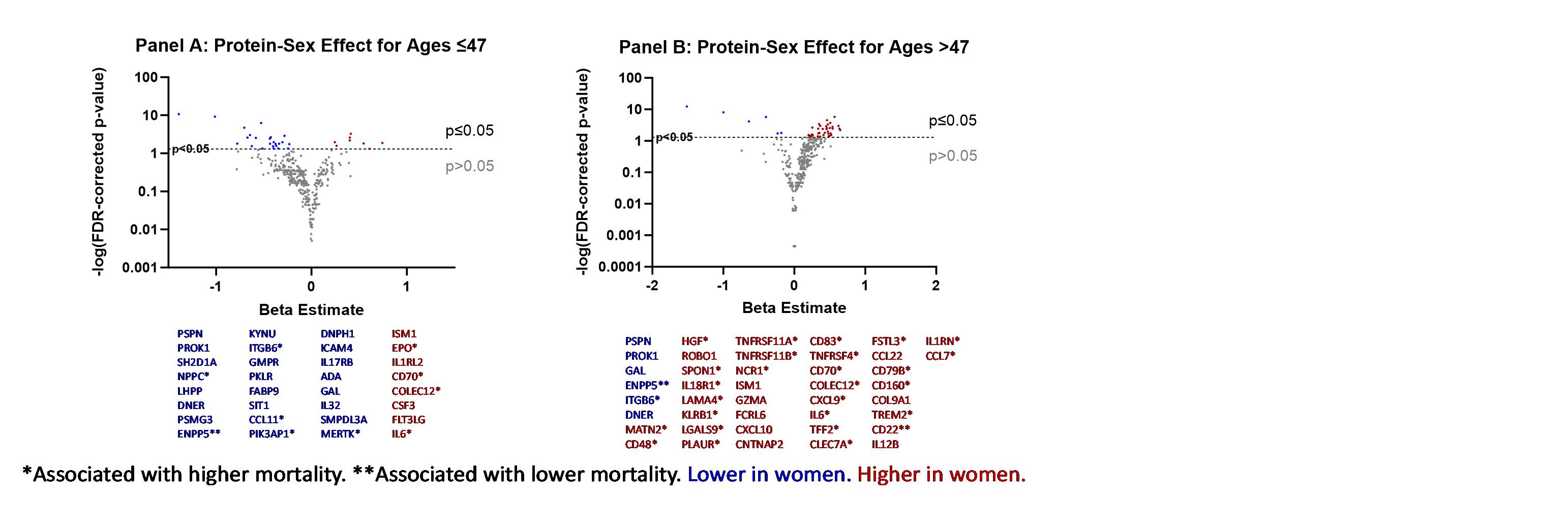
Of the 922 ART-suppressed participants sampled, 103 died over a median follow-up of 9 years. Median age was 47; 162 (18%) were female. Median current and nadir CD4 count were 579 cells/mm3 and 245 cells/mm3, respectively, with a median ART duration of 5 years. A large number of sex differences in inflammatory markers were identified along with significant evidence for an age-by-sex interaction for 157 of all 363 proteins assessed (43%) after FDR correction. In those ≤47 years (Panel A), women had lower levels of largely immunoregulatory proteins than men, 4 of which were associated with higher mortality in the overall cohort. In contrast, in those >47 years, women had higher levels of predominantly inflammatory markers (36/42) than men, 26 of which were associated with higher mortality in the larger cohort (Panel B). Women also had lower levels of the immunoregulatory protein integrin beta 6 (which activates TGF-β1) than men regardless of age.
Conclusions:
The impact of sex on the plasma inflammatory proteome is highly dependent on age among ART-suppressed PWH, with women exhibiting more inflammation than men primarily at older ages. Whether menopause is responsible for unmasking these sex differences requires further study and is of high importance as many of these pathways are associated with increased mortality.