Background:
The pathogenetic mechanisms behind the development of long-COVID (LC) are largely unknown. Because both plasma SARS-CoV-2 RNAemia and dysregulated immunity have been correlated with COVID-19 severity, we evaluated whether they are associated with LC.
Methods:
We consecutively enrolled unvaccinated hospitalized COVID-19 patients during acute-COVID-19 (T0) in March-October 2020 who either developed LC at a follow-up visit 2-3 months from virologic clearance (T1) or did not. LC was defined as persistence ≥2 months after recovery of ≥1 symptom: anosmia, dysgeusia, fever, gastrointestinal symptoms, dyspnoea, fatigue, musculoskeletal pain, muscle weakness, brain fog. We measured: SARS-CoV-2 RNAemia (RT-qPCR, log10(copies/mL)), magnitude (ELISA, AUC) and functionality (pseudovirus neutralization, ID50; Fc-mediated functions, %ADCC) of SARS-CoV-2-specific antibodies, SARS-CoV-2-specific B and CD4-T-cells (Immunophenotype, AIM and ICS assays).
Results:
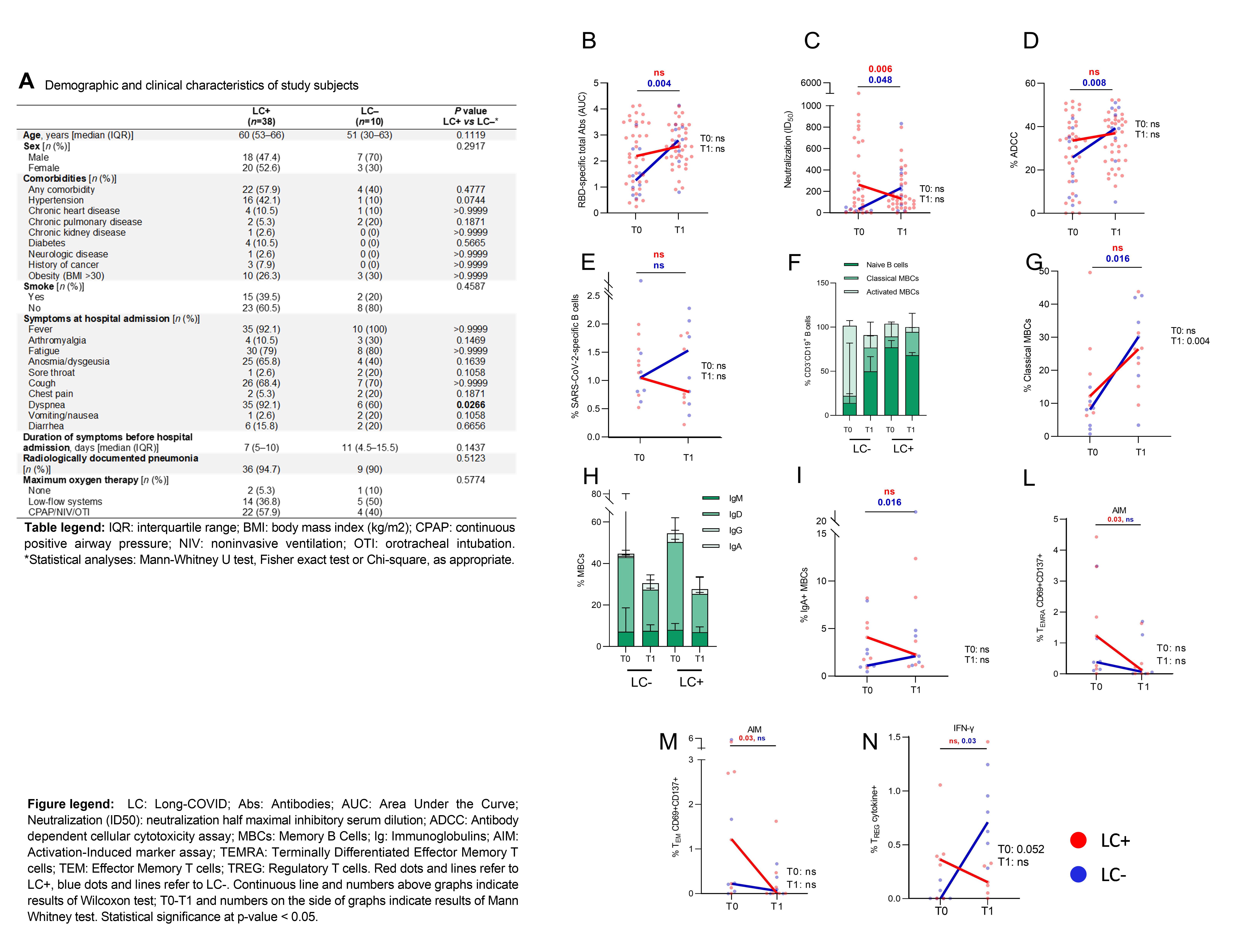
We enrolled 48 COVID-19 individuals, 38/48 (79.2%) developed LC (LC+) and 10 did not (LC-). LC+ and LC- had similar co-morbidities and symptoms in the acute phase (Fig.1A), and the majority showed a radiologically documented SARS-CoV-2 pneumonia. The SARS-CoV-2 RNAemia did not differ between groups at both time points. The levels of RBD-specific Abs, as well as their functionality, appeared to increase over time in the LC- group but not in the LC+ (Fig.1B-D). Similarly, a trend towards increased RBD-specific B-cells was observed over time in the LC- group but not in LC+ (Fig.1E). B-cell immunophenotyping showed a significant increase over time of classical memory B cells (MBCs) at the expenses of activated MBCs (Fig.1F-G) as well as an IgA class-switching in the LC- group compared to LC+ (Fig.1H-I). Furthermore, LC+ showed a faster decline of SARS-CoV-2-specific (CD69+CD137+) CD4-TEMRA and CD4-TEM (Fig.1L-M). Finally, IFN-γ-producing TREG of LC- individuals increased over time (Fig.1N).
Conclusions:
Acutely ill, hospitalized COVID-19 patients developing LC feature a dysregulated SARS-CoV-2-specific humoral as well as B- and T-cell response, in both magnitude and functionality, suggesting a link between dysregulated SARS-CoV-2-specific adaptive immunity and LC development. The fine understanding of the factors contributing to such dysregulation in LC patients is strongly needed, that might further inform targeted therapeutic interventions.
Figure 1