Background:
Molecular Epidemiology is the 4th pillar of the Ending the HIV Epidemic plan, and it is hoped that the use of these analyses will lead to both prevention and treatment interventions in at-risk populations. Concern has been voiced that the inferences derived from molecular epidemiological (ME) analyses could be used in criminal and civil litigation. However, the level of concern is impacted by the accuracy of these analyses. Here we assessed the accuracy of ME analyses to identify correct transmission pairs and the correct direction of transmission in a simulated HIV epidemic.
Methods:
An agent-based simulation based on the EpiModel software package was parameterized to fit the San Diego HIV epidemic among MSM. The simulated data, which included information of who transmitted to whom and time of transmissions, were used to simulate HIV genetic sequences for the corresponding individuals, incorporating time from infection to sampling. Both full length consensus and next generation sequences (NGS) were generated. These sequences were then analyzed to measure the ability of consensus and NGS to predict correct linkage and directionality. We then repeated the analyses varying sample fraction, portion of genome sequenced, human migration in and out of the region of interest, and the inclusions of assays for testing recency of infection when inferring who infected whom.
Results:
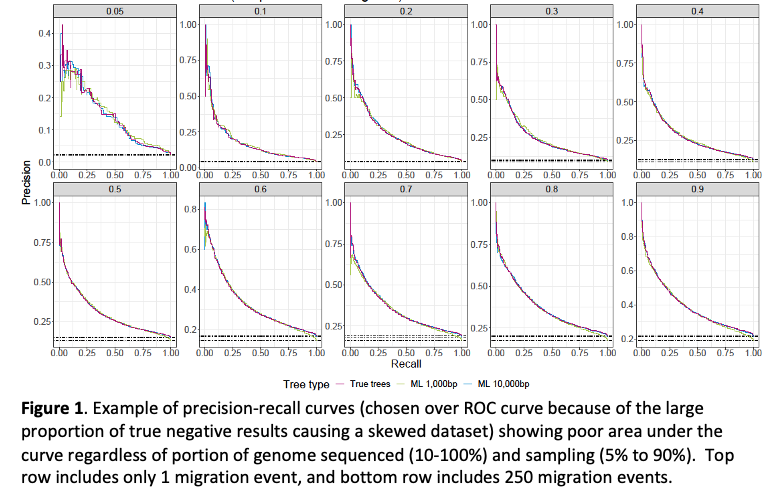
Consensus sequences did not reliably predict correct directionality and linkage, regardless of sampling depth. See Figure 1. For NGS data, given the intense computation burden associated with analyzing these sequences, we chose pairs of individuals where the sequence data had a high likelihood of correctly identifying both linkage and transmission direction (infector probability >80%). Within this subset, we found a sensitivity that ranged from 67.5 to 77.5% and specificity from 89.9 to 92.3%.
Conclusions:
The accuracy of inference of directionality and linkage in a large epidemic using molecular epidemiology is low when consensus sequences are used. However, accuracy increases considerably if additional epidemiologic data leading to a high pre-test probability are available, and NGS data are used.
Precision-Recall Curves with Varying Parameters