People living with HIV (PLWH) are characterized by altered brain structure and function. As they attain normal lifespans, it remains unclear whether HIV accelerates aging in select subgroups. Additionally, the relationship between viral load (VL) and brain aging has not been fully investigated.
Three groups were evaluated: HIV uninfected (HIV-) controls (n=206), PLWH with undetectable VL (?50 copies/mL; n=230), and PLWH with detectable VL (>50 copies/mL; n=93). A subset of individuals (n=201) completed longitudinal follow-up (mean=2.3 years post-baseline). T1-weighted structural imaging (TR/TE=2400/3.2ms) was used with a deep-learning algorithm to predict brain age based on a pre-trained model of healthy individuals. The gap between predicted and actual age (?age) evaluated structural aging. Pseudo-continuous arterial spin labeling (TR/TE=3500/9.0ms, labeling=1500ms, post-labeling delay=1200ms) was obtained to calculate gray matter cerebral blood flow (CBF). Cognition was assessed with a 15-test battery that covered five domains. Mixed-effects linear models tested the prediction that detectable HIV VL was associated with accelerated aging as measured by greater reduction in CBF or increased structural ?age. Age, sex, and race were included as covariates. Relationships between cognition and CBF or ?age were explored.
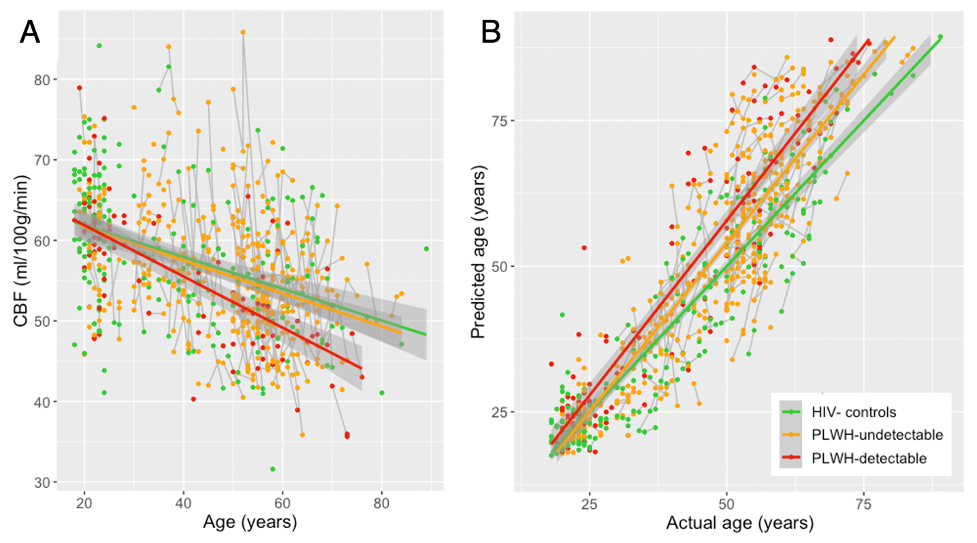
Age-associated CBF decline was not different between PLWH and HIV- controls. However, CBF reduction was accelerated in PLWH who had detectable HIV VL vs. undetectable HIV VL (p=0.02, A). In general, PLWH had accelerated structural ?age increases vs. HIV- controls (p<0.001, B), while structural aging did not differ between PLWH who had detectable and undetectable HIV VL. These effects represented significant age*group interactions. PLWH as a whole had reduced performance in executive function, psychomotor speed, and language, and those with detectable HIV VL had greater impairment in psychomotor speed and language (p's<0.05). No association was observed between CBF and cognition. Across all participants, psychomotor slowing was associated with increased ?age (p<0.001).
Brain aging in PLWH included accelerated loss of gray matter perfusion and morphological alterations detected using machine learning. Cerebrovascular changes are sensitive to current HIV VL, while structural aging correlated with HIV serostatus but not HIV VL. Structural aging likely reflects cumulative gray and white matter degeneration, and is associated with cognitive function.