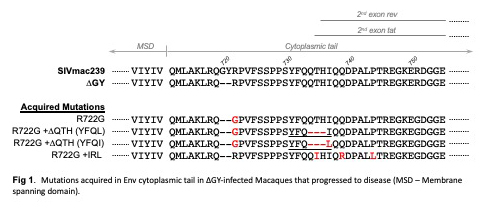
The cytoplasmic tail of HIV and SIV Envs contain a highly conserved Tyr-dependent sorting motif, YxxØ (x= any a.a.; Ø= an a.a. with a bulky hydrophobic side chain) that mediates clathrin-dependent endocytosis and basolateral sorting of Env. Deletion of Gly and Tyr from this motif in SIVmac239 Env (a.a.720-721), creating a virus termed ?GY, resulted in a novel phenotype in pigtail macaques (PTM) characterized by preservation of gut and blood CD4+ T cells followed by host control and an absence of disease despite robust acute viral replication. Rarely, ?GY-infected PTM progressed to AIDS in association with an R722G Env mutation and deletion of three codons (corresponding to a.a.734-736; QTH) that overlap the rev and tat orfs and create novel YFQI or YFQL sequences reminiscent of the parental YxxØ (Fig.1). We hypothesized ?GY Env had impaired trafficking properties that were reconstituted by the in vivo mutations. We assessed the consequences of these changes in vitro and in vivo.
Env expression was assessed using infected cell lines. Reporter constructs previously validated for quantifying trafficking of SIV/HIV Envs, were used to assess the impact of R722G and ?QTH Env mutations. PTM were inoculated with ?GY containing R722G ± ?QTH and animals followed for plasma viral RNA and viral evolution.
In vitro, the ?GY mutation decreased Env content in cells and on virions by 40%. An R722G mutation restored Env expression but had no effect on Env trafficking. In contrast, the ?QTH mutation reconstituted potent Tyr-dependent signals for both endocytosis and basolateral sorting. In PTM, ?GY containing both R722G and ?QTH Env mutations was associated with high viral loads and were maintained throughout infection. Two animals that received ?GY containing only R722G developed high viral loads and AIDS in association with further mutations: One animal developed a ?QTH; the second acquired three point mutations creating a novel motif (IRL; Fig.1) that conferred basolateral sorting but not endocytosis. In vivo, when introduced onto a ?GY background the IRL mutations were completely conserved and sufficient to maintain high viral loads in four PTM.
These findings reveal strong selection pressures on signals for Env endocytosis and basolateral sorting and reveal a previously unappreciated role for polarized cellular trafficking of Env during pathogenic lentivirus infection.