Background:
Age-related comorbidities and toxicities of some antiretrovirals (ART) limit treatment options for the aging population of people living with HIV. We evaluated the efficacy and safety of switching older adults from a first-line regimen to bictegravir/emtricitabine/tenofovir alafenamide (B/F/TAF).
Methods:
The B/F/TAF-elderly study is an open-label, randomized, active controlled, non-inferiority trial conducted at two sites in Kenya. Participants include HIV-1 positive older adults (≥60 years) on any first line regimen with HIV RNA <50 copies/mL for at least 12 weeks prior to enrolment and randomized 1:1 to switch to B/F/TAF or continue current ARV regimen (CAR). The co-primary endpoints are proportion of participants with HIV-1 RNA ≥50 copies/mL at week 48 in the intention-to-treat-exposed population using FDA Snapshot algorithm with a non-inferiority margin of 4%, and mean percentage change in lumbar spine bone mineral density (BMD) from baseline to week 48. The trial is continuing to week 96. ClinicalTrials.govNCT0524360
Results:
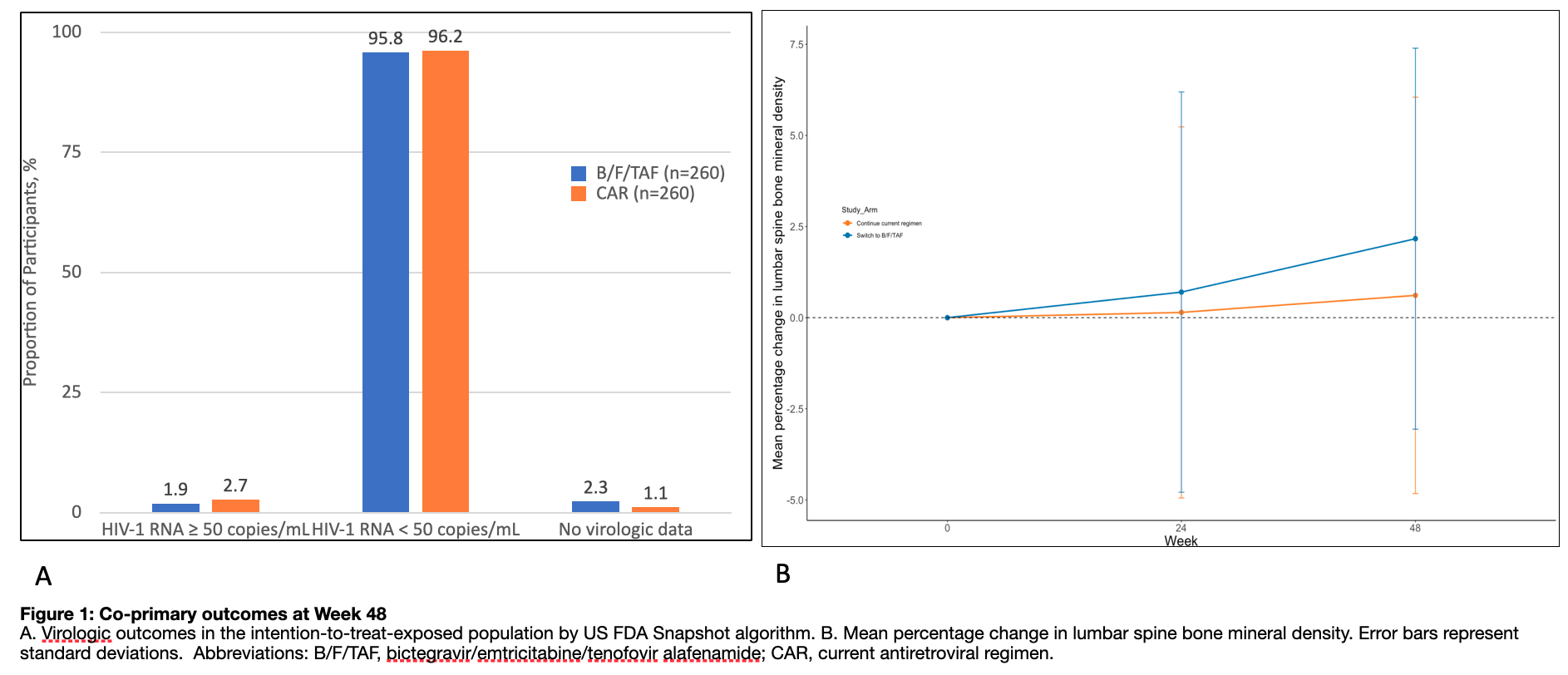
Between Feb and May 2022, 520 participants were randomized and received treatment (260 B/F/TAF, 260 CAR). Of these, 296 were enrolled in the BMD monitoring population (143 B/F/TAF, 153 CAR). All participants were black, median age 64 years (range 60-80), 267 (51%) were female, with baseline characteristics balanced between arms. At baseline, 495 (95%) participants were on tenofovir disoproxil fumarate (TDF) and 177 (60%) of the BMD population had osteoporosis. At week 48, 5/260 participants (1.9%) in the B/F/TAF arm and 7/260 (2.7%) in the CAR arm had HIV-1 RNA ≥50 copies/mL (difference [95% CI], -0.8% [-3.4 to 1.8]), meeting non-inferiority criteria (Figure 1A). No participant with protocol defined virologic failure met the threshold for drug resistance testing of ≥500 copies/ml. The mean percentage change in lumbar spine BMD was +2.17% (SD 5.23) in the B/F/TAF arm and +0.61% (SD 5.44) in the CAR arm (difference [95% CI], 1.56 [0.32 to 2.79], p=0.014, Figure 1B). Grade 3 or 4 adverse events (AEs) were uncommon (3.1% on B/F/TAF; 2.3% on CAR) with no treatment-related serious AEs. Participants discontinuing study drug due to any AE was 1 (0.4%) on B/F/TAF and 15 (5.8%, all due to declining kidney function) on CAR.
Conclusions:
Switching to B/F/TAF may be effective and safe for virally suppressed adults ≥60 years on a TDF containing regimen and is associated with improvement in BMD and fewer requirements for regimen modification due to worsening kidney function.