Background:
Antivirals and monoclonal antibodies (mAbs) were approved for early treatment of COVID-19 based on data from trials conducted in unvaccinated people before the Omicron era. The comparative effectiveness of different treatments is unknown. We present the results of the interim analysis of MONET trial (EudraCT: 2021-004188-28).
Methods:
In this ongoing multicenter, open-label, phase 4 trial, we randomly assigned, in a 1:1:1 ratio, non-hospitalized patients with early symptomatic Covid-19 (≤5 days after symptoms onset) and >=1 risk factor for disease progression, to receive 500 mg of intravenous sotrovimab (SOT) or 600 mg of intramuscular tixagevimab/cilgavimab (TIX/CIL) or oral 5-days course of NMV/r 300/100 mg BID. Primary outcome was hospitalization or death for any cause within 29 days after randomization, reported as cumulative incidence per 100 (95% CI), and P-value calculated by Fisher’s exact test. Inflammatory marker (CRP, d-dimer, and neutrophils-to-lymphocytes ratio) and antibody level (serum anti-S IgG and anti-N IgG) analysed by mixed linear regression with random intercept and P-values for time trend calculated by ANOVA-style test with Bonferroni correction.
Results:
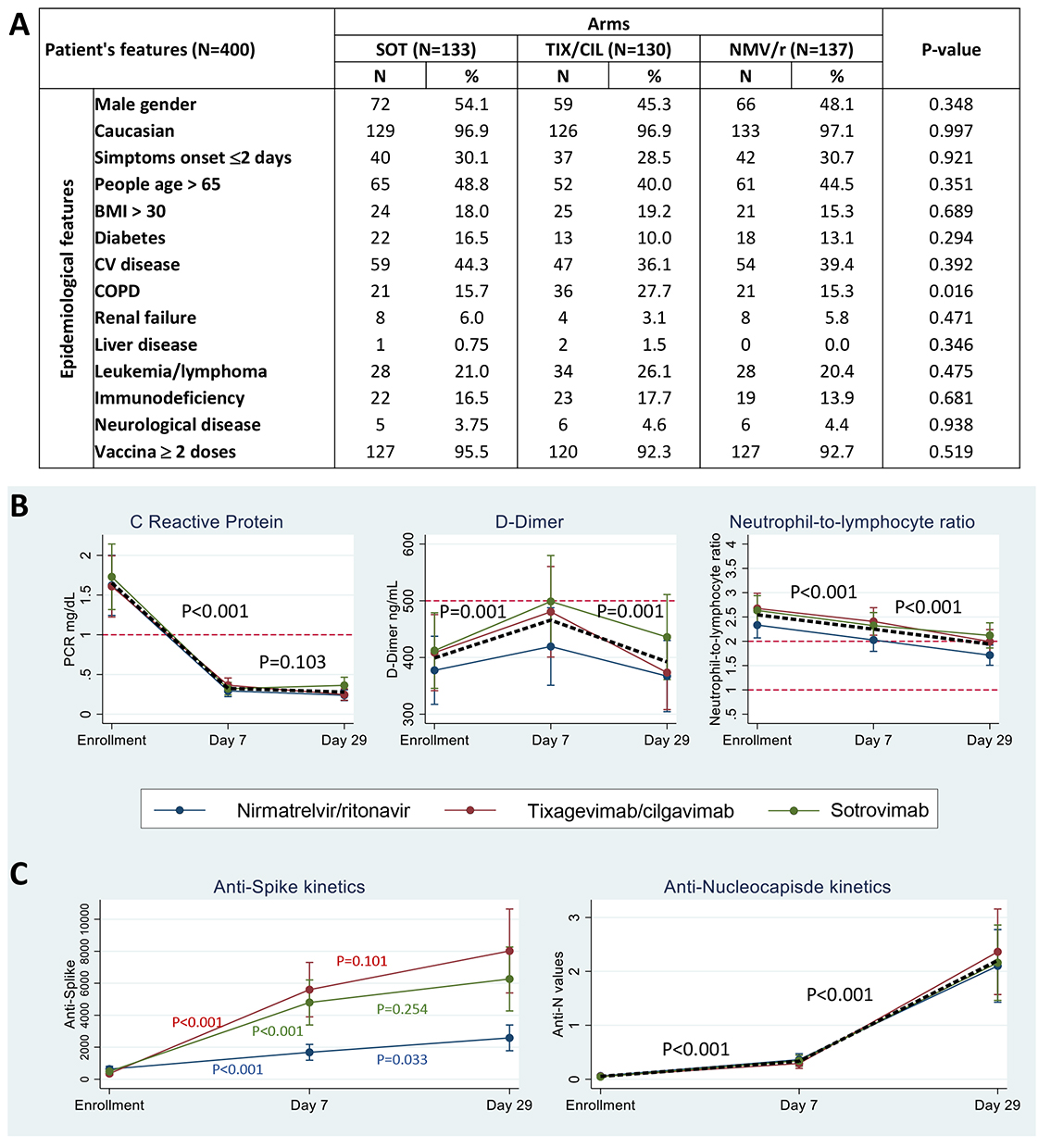
Prespecified interim analysis, including 400 patients (SOT =133, TIX/CIL=130, NMV/r=137) enrolled from Mar 4 to Nov 16, 2022 (Fig.1A). Overall, 5 pts (3/5 immunosuppressed) had disease progression leading to hospitalization [1.25% (95% CI 0.4%-2.89%)], 1 in SOT (0.75%, 95% CI 0.01%- 4.1%), 4 in TIX/CIL (3.08%, 95% CI 0.84%-7.69%) and none in NMV/r arm (P=0.030). No deaths or ICU admissions were observed. Among the hospitalized pts, 3 were infected with BA.2 (1 SOT, 2 TIX/CIL), one with BA.4/5, and one BQ.1.1 (both TIX/CIL). No serious adverse events and no kidney or liver toxicity were reported. Temporal trend of inflammation markers was similar in the three arms, and their estimates are shown in Fig.1B. Kinetics of antibody was reported in Fig.1C. The plot shows a rapid increase of anti-S in both mAb arm and a linear increase of IgG in the NMV/r arm. Anti-N IgG kinetics was similar in the three arms.
Conclusions:
By these data the overall cumulative risk of clinical failure in mild Covid-19 occurring in the Omicron era is low. The hypothesis that differences in clinical progression among the three arms could be related to different activity against the Omicron subvariant observed in vitro should be further investigated. Type of treatment does not seem to influence the development of the natural antibody response.
Figure 1. A. Main patients’ characteristics across the 3 randomized arms; B. Inflammatory marker (CRP, d-dimer, and neutrophils-to-lymphocytes ratio) and C. antibody level (serum anti-S IgG and serum anti-N IgG) analysed by mixed linear regression model with random intercept and P-values for time trend calculated by ANOVA-style test with Bonferroni correction. SOT=sotrovimab; TIX/CIL=tixagevimab/cilgavimab; NMV/r=nirmatrelvir/ritonavir; COPD=chronic obstructive pulmonary disease; CV=cardiovascular; CRP= c reactive protein.