Background:
HCV elimination is unlikely without curing people who inject drugs (PWID). Many PWID will need additional support to achieve HCV cure, but resources are limited, particularly in low-and-middle-income countries. A precision approach could improve the efficiency of intervention delivery. The STOP-C trial evaluated whether HCV treatment outcomes could be optimized by tailoring adherence support to PWID need across community-based centers in 7 cities across India.
Methods:
We implemented a precision randomized trial where arm assignment probabilities varied by participants’ estimated probability for HCV treatment failure. A prediction model generated a prognostic score that classified persons as low or high-risk for failure. Those at high-risk were randomized 3:2:1 to patient navigation + flexible directly observed therapy with ≥1 weekly dose observed (PN+DOT), PN contact ≥ every 2 weeks (PN only) or basic support. Those at low-risk were randomized 1:2:3 to PN+DOT, PN only or basic support. All had a history of drug injection and were treatment naïve; those with decompensated cirrhosis were excluded. All received sofosbuvir/velpatasvir once daily for 12 weeks. The primary outcome, sustained virologic response (SVR; HCV RNA < LLOQ 12 weeks after treatment completion) was compared by Poisson regression adjusted for site (intent to treat, missing=failure).
Results:
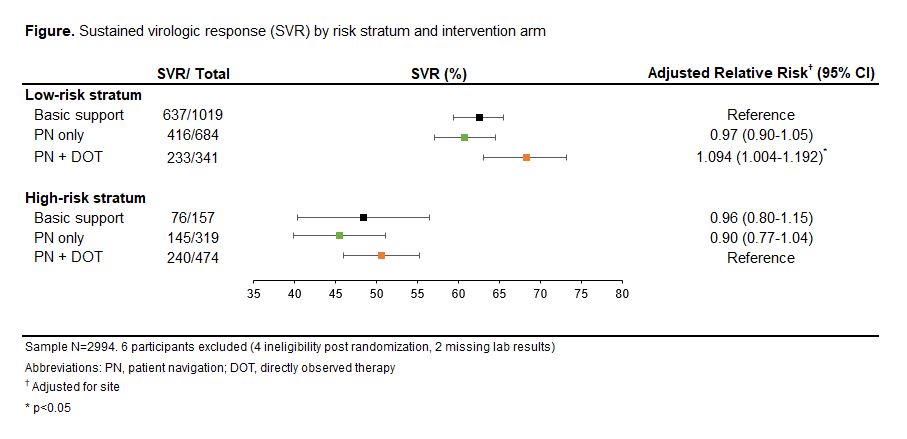
3000 participants were recruited from Jan 2021-Dec 2022 (2048 low-risk, 952 high-risk). Compared with participants in the low-risk stratum, those in the high-risk stratum were more likely to be younger (median 27 vs. 31), experience homelessness (26% vs 6%) and report active drug injection (89% vs. 42%). 2798 (93%) completed SVR assessment. 49% and 63% achieved SVR in high and low-risk strata, respectively. In the high-risk stratum, SVR in PN+DOT was similar to PN only and basic support. In the low-risk stratum, SVR in PN+DOT was associated with a statistically significant 9% increase in SVR vs. basic support (adjusted relative risk [aRR] 1.09; p=0.04) but did not differ in PN only vs. basic support (Figure). Within strata, SVR significantly increased with better prognostic score (aRR per 10% decrease: 1.04 low-risk, 1.10 high-risk; p<0.01 for both).
Conclusions:
Greater adherence support or long-acting treatments may be required to improve cure rates among PWID at highest risk for failure. However, programs could use prognostic scores to target interventions more efficiently and proactively address barriers to treatment adherence.