Background:
Post-integration HIV latency is the major hurdle for a cure. To counter HIV latency, it is important to develop a better understanding of the full range of host factors promoting latency. Their identification could suggest new strategies to achieve a functional cure. We recently developed a genetic screening strategy termed “Reiterative Enrichment and Authentication of CRISPRi Targets” (REACT) and unambiguously identified several Silencing Promoting Agents (SPAs) even in the presence of high background “noise” produced by the stochastic nature of HIV reactivation.
Methods:
In the current study, we modified the REACT method to look for synergies between Silencing Promoting Agents (SPAs) across the human genome. As a proof-of-concept, we used 7 SPAs to conduct 7 parallel screen to look across the human genome for factors that synergize with them to block HIV reactivation.
Results:
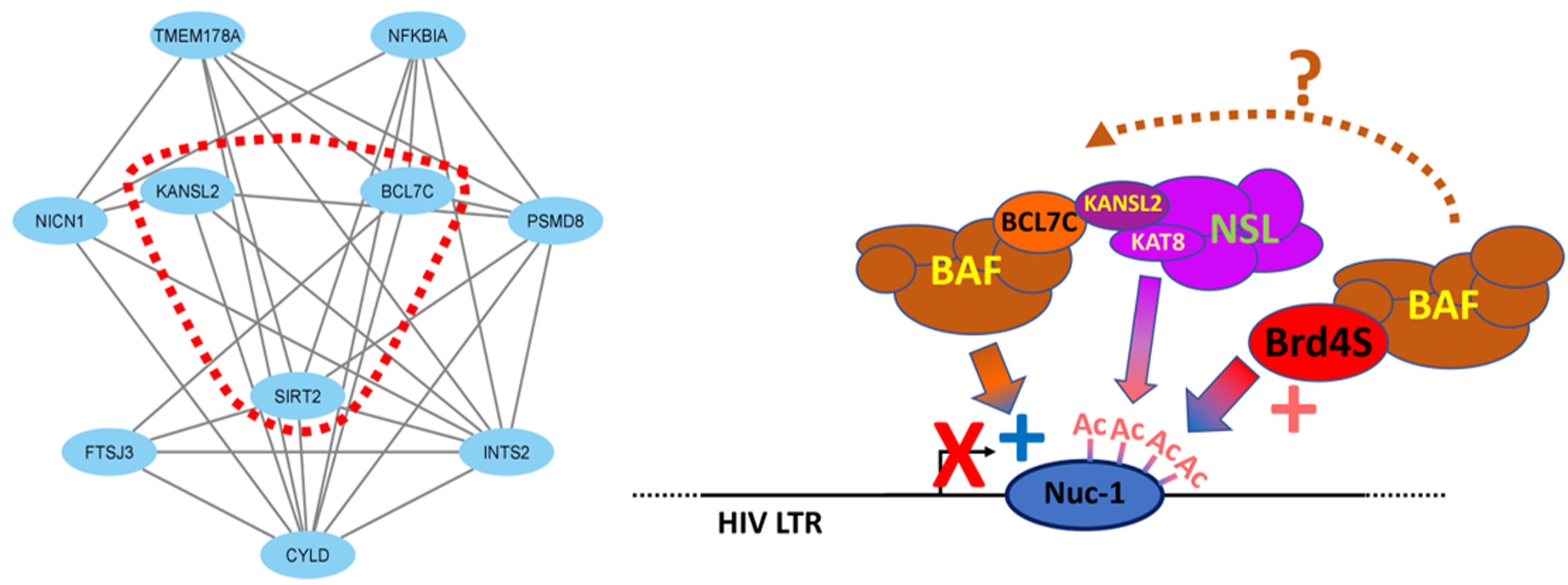
We identified thirty synergies among ten SPAs. Three of them (BCL7C, KANSL2, SIRT2) are previously unrecognized. Overexpression (OE) of BCL7C, KANSL2 and SIRT2 reduced spontaneous and PMA-induced HIV reactivation in J-Lat A2 cells, a Jurkat-based HIV latency model, as well as in CD4 T cells from people living with HIV. These factors inhibit HIV reactivation through different mechanisms: we found OE of BCL7C and KANSL2 increased histone acetylation on the HIV promoter (LTR) region on chromatin, and this in turn resulted in more Brd4S (an inhibitor for HIV transcription) binding to the HIV LTR. In contrast, OE of SIRT2 decreased histone acetylation on HIV LTR. BCL7C is part of the SWI/SNF nucleosomal remodeling complex, while KANSL2 is a regulatory subunit of the KAT8 (MOF) histone acetylation complex. Interestingly, our data demonstrate that BCL7C and KANSL2 are interacting with each other together with a set of proteins from the BAF and NSL subclasses of SWI/SNF and MOF respectively.
Conclusions:
Our data indicate that a BAF-NSL super complex in the latently infected cells may hyper-acetylate the HIV promoter to recruit excessive Brd4S to inhibit HIV reactivation. Identification and mechanistic characterization of this nucleosomal modification complex indicate that increasing the loading and function of this complex on HIV LTR might enhance HIV silencing.
A BAF-NSL super complex inhibiting HIV by Brd4S-BAF pathway identified through systematic mapping of genetic interaction networks for HIV latency