Background:
ACTG A5321, a prospective study of HIV-1 reservoirs among persons with HIV on antiretroviral therapy (ART), previously showed detection of HIV DNA in cells from cerebrospinal fluid (CSF) was associated with poorer global cognitive function. We conducted a cross-sectional analysis of antiretroviral (ARV) pharmacokinetics (PK) in CSF and investigated relationships among a novel measure of ART regimen activity and HIV persistence in CSF and cognitive function.
Methods:
Participants were on ART for a median of 8.1 years with sustained plasma HIV suppression at time of lumbar puncture (LP). CSF ARV concentrations, cell-associated HIV DNA and inflammatory biomarkers were measured; a neuropsychological test battery (outcome=global deficit score, GDS) was administered just prior to or at LP. ARV levels were quantified by LC/MS/MS. Population PK modeling was used to estimate CSF drug exposure. CSF inhibitory quotients (IQ) were calculated for each ARV in a regimen as ratio of predicted CSF trough to literature values for in vitro HIV inhibitory concentration (i.e., IC50, IC90). The geometric mean of CSF IQs of all drugs in each participant’s ARV regimen was calculated (ART-IQ-GeoM). Statistical analyses evaluated associations among the ART-IQ-GeoM and CSF HIV DNA, biomarkers and GDS.
Results:
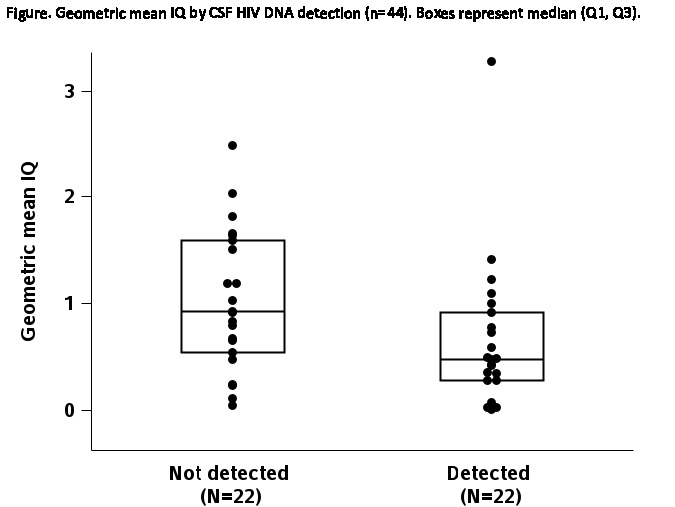
CSF ARV levels were measured in 44 chronic-treated participants on TDF/FTC-based ART: 43 (98%) male sex at birth; 36 (97% of 37) male gender; 33 (75%) white non-Hispanic, 6 (14%) black non-Hispanic; median age, 49 yrs; median CD4 count, 642 cells/µL; 43 (98%) with plasma HIV RNA <40 copies/mL. Third drugs in ARV regimens were: EFV (n=17), ATV/r (8), RAL (8), EVG/c (5), DRV/r (4) and DTG (2). The median (Q1, Q3) ART-IQ-GeoM was higher in those with undetectable vs detectable CSF HIV DNA 0.9 (0.5, 1.6) vs 0.5 (0.3, 0.9), p=0.027 (Figure). A rank-based analysis gave similar findings. Higher ART-IQ-GeoM was associated with lower GDS (i.e., better global cognitive function, Spearman: -0.30, p=0.05). There was no association between CSF inflammatory biomarkers and ART-IQ-GeoM.
Conclusions:
The ART IQ metric is a new approach to assess ART regimen activity. Higher ART-IQ-GeoM was associated with a lack of detection of CSF HIV DNA and better global cognitive function. These findings suggest ART regimen activity affects HIV persistence in CSF. This tool provides a basis for further investigations of relationships between regimen activity and biomarkers of HIV persistence in the CSF and other viral reservoirs.