Background:
In Mexico until 2018, first line antiretroviral therapy (ART) was mainly based on either efavirenz-containing regimens (despite reports of high pre-treatment resistance levels); or on other regimens with drugs no longer considered optimal -protease inhibitors (PIs), nevirapine, maraviroc and first-generation integrase inhibitors (InSTIs)- all of them amenable to be switched to 2nd generation INSTIs as a single tablet regimen (STR). We aimed to evaluate a national optimization strategy through a rollout program using second-generation INSTI-based STR both for ART initiation and switch.
Methods:
SALVAR (National System for Antiretroviral Surveillance and Administration) database was used for the analysis. We included adults registered in SALVAR, who started on ART or switched to BIC/TAF/FTC, from June 1st 2019 to June 30th 2021. We categorized them as “started BIC/TAF/FTC” (G1), “started other than BIC/TAF/FTC” (G2) or “switched to BIC/TAF/FTC” (G3). We calculated the proportion of participants with viral suppression (VS) (< 40 copies/ml) at 6 months after ART initiation by group. We described VS and ART change by group at end of follow-up and fitted a Cox model to compare durability by group, sex and age. Durability was defined as maintaining the same ART versus changing ART regimen, LTFU or death.
Results:
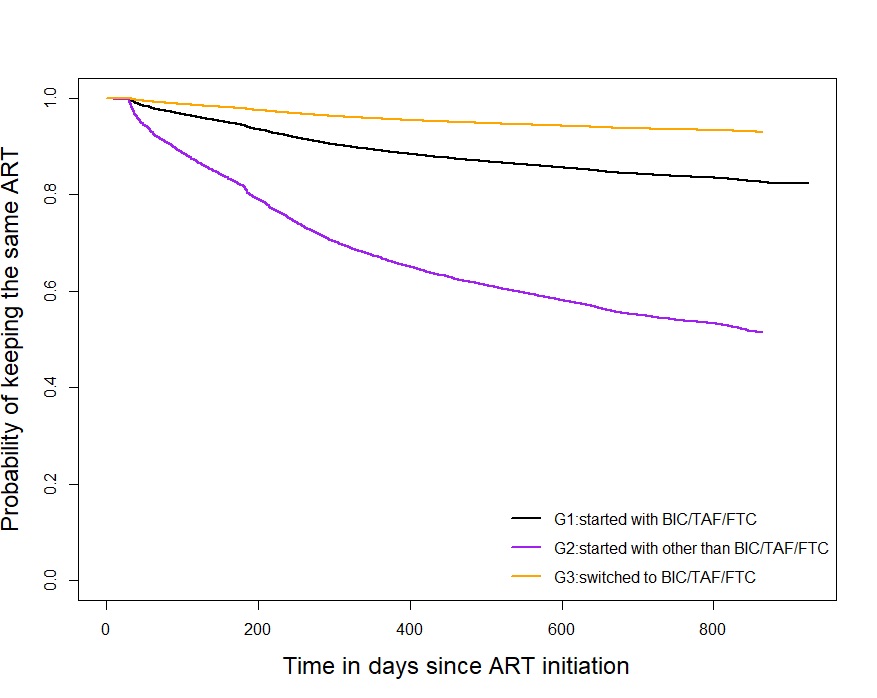
A total of 74,137 PLWH were included in the analysis and followed for a median of 1.6 years (IQR: 0.8-2.1), 23,786 (31%) were classified as G1, 5352 (7%) as G2 and 44,999 (61%) as G3. Of those classified as G2: 2543 (47.5%) were started on NNRTI’s, 2021 (37.7%) on other INSTIs and 602 (11.2%) on PIs. The last regimen before switch in G3 group, was based on NNRTI’s in 67%, PI’s in 19%, other INSTIs in 10% and other regimens 4%. VS at 6 months after initiation or switch was observed in 87% individuals in G1, 80% in G2 and 98% in G3. At end of follow-up, 80% of those in G1, 56% in G2, and 87% in G3 remained with VS; < 1% of individuals changed to a different regimen in G1, 4% in G2 and 1% on G3. Durability of ART regimen by group is shown in Figure 1. At initial evaluation, 31% of all individuals were on a STR regimen, vs. 96% at the end of follow-up.
Conclusions:
In this real-life analysis, we observed that second generation INSTIs represent an effective and durable option for treatment optimization in the Mexican National treatment program.
Figure 1.- Durability of the same ART regimen by group.