Background:
Traditional metrics of retention in HIV care fall short of quantifying the dynamic process of engagement and disengagement from care over time. Novel longitudinal analytic approaches reveal more nuanced care trajectories for people living with HIV (PLWH), thus providing stronger evidence to improve service delivery. We conducted a multistate analysis to describe transitions in and out of care and comprehensively represent longitudinal outcomes in Missouri, an Ending the HIV Epidemic priority state.
Methods:
We analyzed electronic health record data collected from PLWH ≥ 18 years who were newly or presumed newly linked to care at a large Ryan White-funded HIV primary care clinic in St. Louis, Missouri between January 1, 2015 and March 15, 2020. We estimated the prevalence of 9 mutually exclusive and exhaustive care states over the 3 years following linkage to clinic based on 1) retention status (retained, disengaged, re-engaged) and 2) viral load (VL) status (virally suppressed (VS), viremic, unknown/late VL). Disengaged was defined as > 90 days late for a scheduled appointment. VS was defined as a VL < 200 copies/mL ≤ 200 days; viremic as VL > 200 copies/mL ≤ 200 days; and unknown/late VL as a gap in VL measurement > 200 days.
Results:
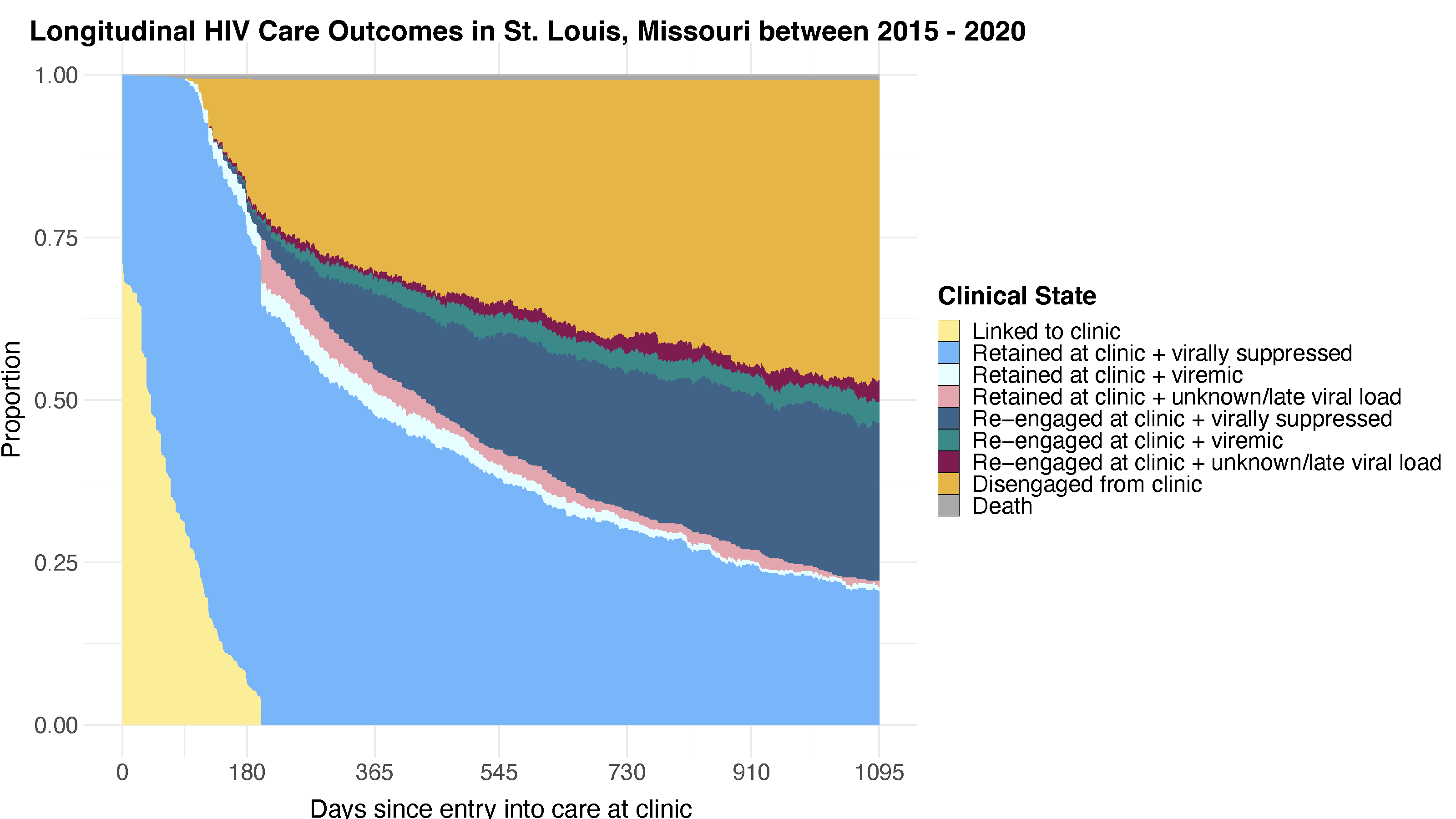
1,110 patients were newly linked to the clinic during the observation period, contributing 2255.4 person-years of follow-up. Median age was 34 years (IQR 25-47), 865 (77.9%) were male, 745 (67.1%) identified as non-Hispanic Black, and 229 (20.6%) were 18-24 years at entry. Three years following linkage to clinic, 53.1% (95% CI: 50.0, 56.2) were in care (22.3% continuously retained, 30.8% re-engaged, Figure). Regarding VS, 92.7% of those continuously retained were VS compared to 78.7% who had re-engaged in care. Although 69.4% were retained with VS at 6 months, 29.2% and 46.2% disengaged at 1- and 3 years, respectively. Among those who disengaged, 61.2% (95% CI: 57.4, 65.0) re-engaged and 40.2% (95% CI: 36.4, 44.0) were VS after one year.
Conclusions:
Disengagement, re-engagement, and viremia over time are far more common than previously reported in Missouri. While engagement is initially strong, subsequent disengagement and re-engagement are high in the first year following linkage to care, with uncertain outcomes among those who do not re-engage. Multistate analyses can strengthen our understanding of such tenuous timepoints in the care continuum, highlighting important targets for optimizing lost-to-care and re-engagement services to end the epidemic.