Background:
Antiretroviral therapy (ART) containing integrase strand transfer inhibitors (INSTI) has been associated with weight gain in both ART-initiation and switch studies, especially in women, but the underlying mechanisms of sex-difference are unclear. Estrogen is recognized as a master regulator of the energy homeostasis and is a major determinant of sex differences in the control of energy homeostasis. Hence, we hypothesized that INSTIs may interrupt adipose function via estrogen receptor.
Methods:
Estrogen receptor-mediated transcriptional activity was measured by luciferase reporter containing estrogen response element in the presence of dolutegravir (DTG), doravirine (DOR) and efavirenz (EFV). Estrogen receptor α (ERα) deficient cells were created from primary preadipocytes isolated from female mice (ERαloxp/loxp) using a Cre/loxp system. Cells were treated with DTG for 8 days during differentiation into mature white or brown adipocytes. Mature adipocytes were analyzed for lipid accumulation by Oil Red O Staining, adipogenic markers by qRT-PCR and immunoblotting.
Results:
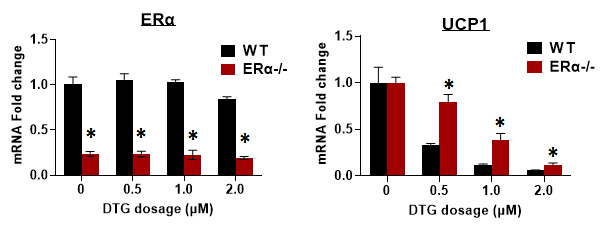
We found that DTG treatment reduced estrogen-mediated ERE-reporter activity in a dose dependent manner and half of Cmax value of DTG (2.5 uM) was sufficient to completely suppress reporter activity. However, DOR and EFV had no effect. We found that a genetic deletion of ERα by Ad-Cre alone did not affect overall adipogenesis as adipogenic markers (PPARγ, FABP4, and CEBPα/β) levels and lipid accumulation by Oil Red O staining were similar between ERα knockout (KO) and wild type (WT) adipocytes. However, a loss of ERα significantly attenuated DTG-mediated suppression of uncoupling protein 1 (UCP1), which is an essential for a thermogenic process in brown/beige adipocytes (Figure), and other brown adipogenesis markers (Dio2, CIDEA) in ERα KO compared to WT adipocytes. In addition, DTG-mediated suppression of mitochondrial respiratory chain, cytochrome oxidase complex IV (COX IV), lipid droplet associated protein 1 (perilipin1), hormone sensitive lipase (HSL) was blocked in ERα KO compared to WT adipocytes.
Conclusions:
Our data showed that DTG inhibits estrogen signaling action modulated by ERα and a genetic deletion of ERα in adipocytes attenuates DTG-mediated suppression of thermogenesis. These findings suggest a novel mechanism by which INSTIs may lead to weight gain potentially in a sex-dependent manner.
Figure. A loss of ERα attenuates DTG effect on UCP1 expression in brown adipocytes (n=6, *, P < 0.05).