Background:
COVID-19 carries a high risk of vascular thrombosis. This joint analysis of two randomized-controlled trials (RCTs) aims to assess the safety and efficacy of enoxaparin at therapeutic dose compared to prophylactic dose in people hospitalized with COVID-19.
Methods:
A joint analysis of two RCTs, COVID-19 HD (NCT044082359) and EMOS-COVID (NCT04646655), was performed. Both studies enrolled inpatients with COVID-19- associated respiratory compromise (as identified by respiratory rate ≥25 breaths/min or arterial oxygen saturation ≤93% at rest or PaO2/FiO2 ≤300 mmHg for COVID-19 HD and by PaO2/FiO2 ≤250 mmHg for EMOS-COVID) and/or coagulopathy (D-dimer > 2000 ng/ml for both RCTs or sepsis-Induced coagulopathy score >4 for COVID-HD).In both RCTs patients were randomly assigned to two arms: enoxaparin at prophylactic dose (standard 4.000 IU; in the EMOS-COVID 6000 IU if body weight >100 kg) and at therapeutic dose (70 U/Kg every 12 h).The primary efficacy endpoint of the joint analysis was clinical worsening, defined as the occurrence of at least one among: in-hospital death; acute myocardial infarction; symptomatic arterial or venous thromboembolism; need of either Continuous Positive Airway Pressure (Cpap) or Non-Invasive Ventilation (NIV) in patients who were in standard oxygen therapy at randomization; need for IMV in any patient. The primary outcome was assessed as time-to-event, described with hazard ratio (HR) and with Kaplan-Meier survival estimate.The primary safety endpoint was major bleeding for both trials and for the joint analysis.
Results:
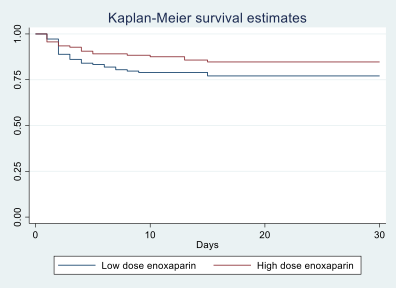
COVID-19 HD enrolled 142 people between July 2, 2020 and February 15, 2022, while EMOS-COVID enrolled 141 people from July 27, 2020 to June 5, 2021, resulting in 283 patients included in this joint analysis. Two-hundred-seven (73.1%) were males, with a mean age of 61.1 years (SD ±10.7), a mean BMI of 29.7 kg/m2 (SD ±5.0), and 115 (40.6%) were on NIV or Cpap at randomization, with no significant difference between the study groups. 21/139 people in the high dose group reached the primary endpoint compared to 32/144 in the prophylactic group (HR 0.63, 95%CI 0.36 to 1.10). Figure 1 shows the Kaplan-Meier survival estimates of clinical worsening. No major bleeding was observed during the study time.
Conclusions:
The results of this joint analysis did not highlight significant differences in clinical worsening between COVID-19 patients that received enoxaparin at therapeutic compared to prophylactic dose.
Figure 1. Kaplan-Meier survival estimates of clinical worsening.