Background:
Non-alcoholic fatty liver disease (NAFLD) has emerged as an increasingly recognized problem among people living with HIV (PLWH). The gut-liver axis is considered to be strongly implicated in the pathogenesis of NAFLD. We aimed to characterize the gut microbiota composition in PLWH and NAFLD and compare it with that of two control groups: PLWH without NAFLD and individuals with NAFLD without HIV infection.
Methods:
We collected clinical data and stool samples from participants. Bacterial 16S rRNA genes were amplified, sequenced, and clustered into operational taxonomic units. Alpha diversity was studied by the Shannon and Simpson indexes. To study how different the gut microbiota composition is between the different groups, beta diversity estimation was evaluated by principal coordinate analysis (PCoA) using Bray-Curtis dissimilarity. To further analyze differences in microbiome composition, we performed a linear discriminant analysis (LDA) effect size (LEfSe). We selected the genus with a LDA score >4.
Results:
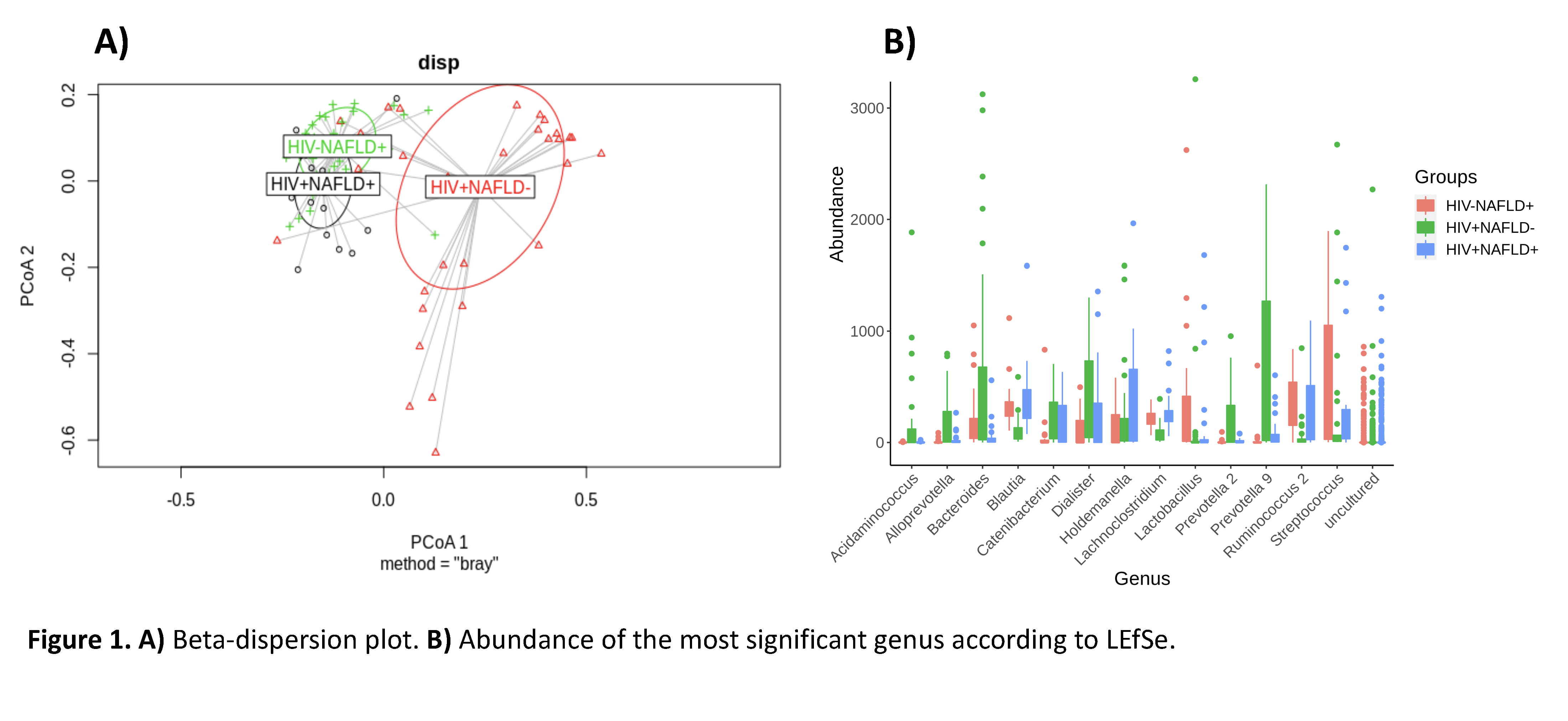
We included 30 HIV+NAFLD+, 30 HIV+NAFLD- and 20 HIV-NAFLD+ participants. Major butyrate producers, including Faecalibacterium, Ruminococcus, and Lachnospira dominated the microbiota in all three groups. Shannon’s and Simpson’s diversity metrics were higher among NAFLD+ individuals (Kruskal-Wallis p = 0.047). Beta diversity analysis showed distinct clustering in NAFLD-, with NAFLD+ participants overlapping regardless of HIV status (ADONIS significance <0.001) (Figure 1A). NAFLD was associated with increased homogeneity across individuals, in contrast to that observed in the HIV+NAFDL- group, in which the dispersion was higher (Permanova test, p value <0.001; ANOSIM, p value <0.001). NAFLD but not HIV determined a different microbiota structure (HIV+NAFLD- vs. HIV+NAFLD+, q-value = 0.002; HIV-NAFLD+ vs. HIV+NAFLD+, q-value = 0.930; and HIV-NAFLD+ vs. HIV+NAFLD-, q-value < 0.001). The most abundant genera in NAFLD- were Prevotella, Bacteroides, Dialister, Acidaminococcos, Alloprevotella, and Catenibacterium. In contrast, the most enriched genera in NAFLD+ were Ruminococcus, Streptococcus, Holdemanella, Blautia, and Lactobacillus (Figure 1B)
Conclusions:
We found a microbiome signature linked to NAFLD, which had a greater influence on the overall structure of the gut microbiota than HIV status alone. We suggest that part of the alterations in the microbiota described as associated with HIV could be confused by the presence of NAFLD, which is more prevalent in people with HIV.