Background:
Effective use of oral pre-exposure prophylaxis (PrEP) has been sub-optimal among young women in sub-Saharan Africa at greatest risk of HIV. We hypothesized that a single dual prevention pill (DPP) combining PrEP and an oral contraceptive (OC) would be preferred, acceptable and increase PrEP adherence compared to PrEP alone.
Methods:
We enrolled 30 HIV-uninfected, non-pregnant, 16-24-year-old cisgender females currently using OCs in a crossover study in Harare, Zimbabwe, who were randomized (1:1) to the order of using an over-encapsulated DPP and 2 separate pills (PrEP, OC) for 3 28-day cycles each. We assessed if the proportion preferring the DPP vs 2 separate pills was >0.5 (exact binomial test) and the effect of regimen on 4 acceptability domains: use attributes, product attributes, side-effects, impact on sex (Wilcoxon signed-rank tests). We compared adherence by regimen and sequence (generalized estimating equations) via self-report and via tenofovir diphosphate (TFV-DP) levels in dried blood spots indicative of ≥4 doses per week (≥500 fmol/punch at Month 1, 700 fmol/punch at Months 2-6). Population Council Institutional Review Board and 6 ethics committees/regulatory bodies in Zimbabwe approved the protocol.
Results:
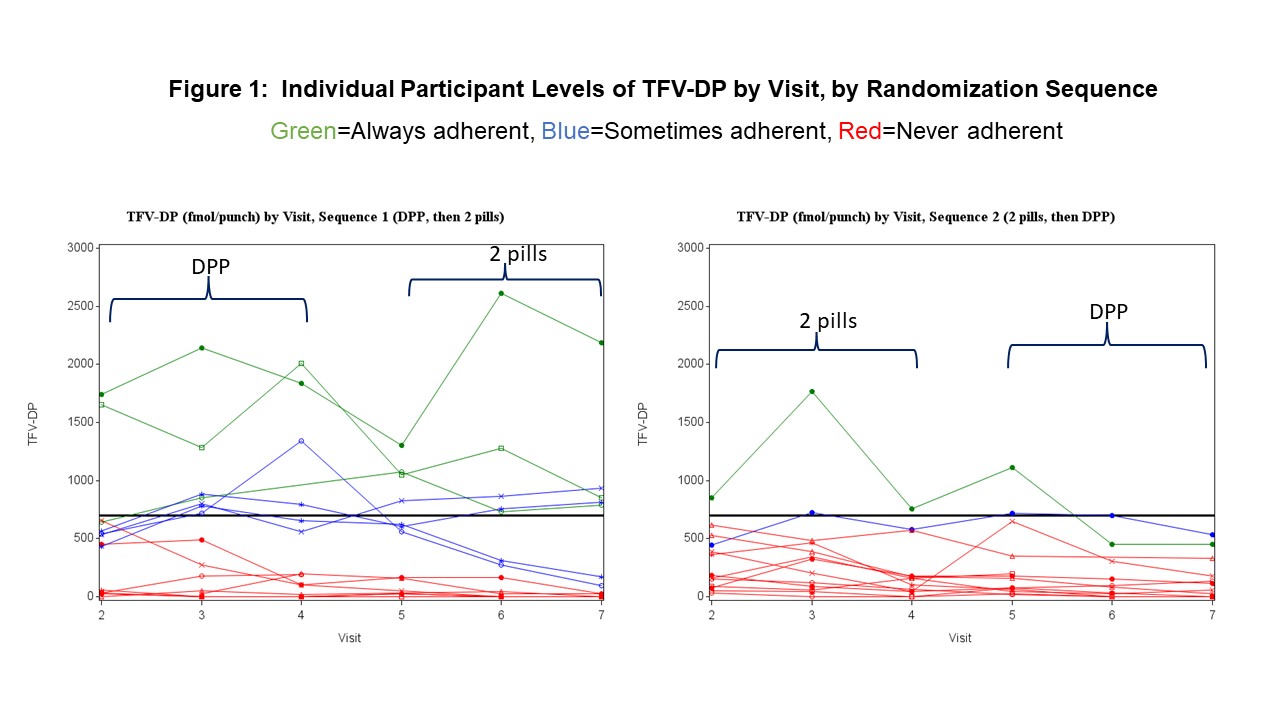
26/30 women (mean age, 19.4 years) completed the study (Nov 2022-Sep 2023); 4 terminated early. Most were married (47%)/divorced (27%), 97% had completed secondary school, 93% had ≥ 1 child, 84% were somewhat/very worried about getting HIV in the next 3 months, and 93% thought it was somewhat/very important to avoid pregnancy. At study exit, preference for the DPP was 64% vs 36% for 2 separate pills (p=0.16). Most rated both regimens as acceptable, with no differences between regimens in any domain (all p>0.05). Self-reported adherence was high (>96%), yet 17-18% were adherent to the 2 pills and DPP, respectively, based on TFV-DP levels, with mean TFV-DP levels only 384 fmol/punch (2 pills) and 392 fmol/punch (DPP). There was no difference in adherence by regimen or treatment period (all p>0.05). Adherence was higher overall among participants starting with DPP vs those starting with 2 pills (not significant, Fig 1).
Conclusions:
While we did not find differences between the DPP and 2 separate pills for any outcome, this small study used an over-encapsulated pill as a proxy for the co-formulated DPP. A larger study with the actual DPP – a smaller pill – will be a better indicator of the potential impact of the DPP on HIV and pregnancy prevention in this population.