Background
Alcohol use can increase the likelihood of condomless sex and other behaviors associated with acquisition of HIV and other sexually transmitted infections (STIs). We assessed alcohol use among adults and adolescents with behavioral risk for HIV in Western Kenya.
Methods
From December 2021 to April 2023, we enrolled participants in Kericho and Homa Bay, Kenya, who were aged 15-55 years, without HIV, and had at least one behavioral risk factor for HIV acquisition (STI, transactional sex, condomless sex, injection drug use, and/or anal sex with male partners in the previous 24 weeks). At enrollment, participants completed behavioral questionnaires that included the Alcohol Use Disorders Identification Test-Consumption (AUDIT-C) scale and the Patient Health Questionnaire-9 (PHQ-9; categorized 0-4=none/minimal, 5-9=mild, ≥10=moderate-severe depression). We estimated adjusted prevalence ratios (aPRs) with 95% confidence intervals (CIs) for factors associated with unhealthy alcohol use (AUDIT-C≥5) and binge drinking (AUDIT-C item 3; ≥6 drinks on one occasion in the past 12 weeks) using multivariable robust Poisson regression.
Results
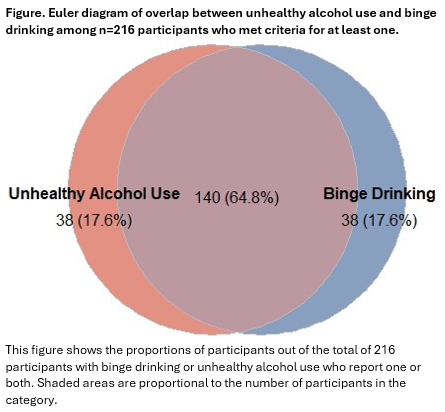
Among 407 participants, the median age was 22 years (interquartile range: 19-24) and 325 (79.9%) were female. Of 393 participants with a non-missing response, 178 (45.3%) reported binge drinking, and of 366 participants with a complete AUDIT-C, 178 (48.6%) had unhealthy alcohol use, with 140/366 (38.3%) meeting criteria for both (Figure). Age >24 years (aPR 1.45 [95% CI 1.09-1.94]) and transactional sex (1.59 [1.02-2.47]) were associated with higher prevalence of binge drinking but not more general unhealthy alcohol use. Occupation in entertainment/hospitality vs other occupation (2.57 [1.52-4.35]; 4.41 [1.91-10.19]) and mild depression vs none/minimal (1.45 [1.13-1.87]; 1.47 [1.17-1.84]) were associated with both binge drinking and unhealthy alcohol use; occupation as a sex worker (2.59 [1.09-6.18]) or fisher vs other occupation (3.98 [1.36-11.62]) were also associated with unhealthy alcohol use.
Conclusions
Prevalences of binge drinking and unhealthy alcohol use were high among people with behavioral risk for HIV in Western Kenya, highlighting the need for strategies to address substance use in this population. Strategies may include integrating mental health and alcohol use disorder services with HIV/STI prevention programs. Differentiated service delivery for sex workers and fisherfolk may help address gaps in reaching these particularly vulnerable groups.
Table or Figure