Background
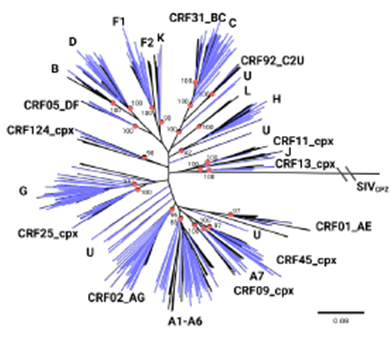
HIV-1 diversified for decades within the Democratic Republic of the Congo (DRC) before spreading globally in the early 1980’s. Despite its epidemiological significance, the DRC has been underrepresented in global HIV-1 surveillance, with only 77 out of the approximately 7000 HIV-1 genomes in the Los Alamos reference database coming from DRC and none of them collected after 2012. Given the history of circulating rare HIV subtypes in DRC, viral whole-genome sequencing was conducted to determine current HIV-1 diversity in the greater Kinshasa area.
Methods
Next-generation sequencing (NGS) through metagenomic and target enrichment methods was conducted on 197 samples collected from Kinshasa in 2017-2019. Phylogenetic inference was assessed with maximum likelihood trees and recombination analysis was conducted for basal sequences. The time to most recent common ancestor (tMRCA) was calculated for subtypes H, J, and G using Bayesian Inference after adding the new sequences from this study. Specimens with sufficient volume were also evaluated for detection using a suite of molecular and serological diagnostics to evaluate performance with diverse strains.
Results
A large array of HIV subtypes (A, B, C, D, F1, G, H, J, K), circulating recombinant forms (CRF01_AE, CRF02_AG, CRF05_DF, CRF11_cpx, CRF13_cpx, CRF25_cpx, CRF 45_cpx, CRF92_C2U), unique recombinant forms and unclassifiable sequences were observed, with many branching basally on phylogenetic trees. All strains were detected with 100% sensitivity on ARCHITECT HIV Ag/Ab Combo, ARCHITECT HIV Ag/Ab Combo Next (Investigation Use assay), m2000 RealTime HIV-1, Alinity m HIV-1, and Determine HIV-1/2 Ag/Ab Combo. Inclusion of the study sequences in Bayesian analysis shifted the origin date of the last common ancestor of subtypes G, H, J, and L from year 1936 to 1915, a difference of 21 years.
Conclusions
In addition to greatly expanding the known diversity of HIV-1 by tripling the number of available genomes from DRC, our study serves as a unique resource for investigating the origins of the virus as evidenced by the impact these new genomes have already had on the origin dating for 4 subtypes. Furthermore, this dataset provides evidence that rare strains hold the potential to spread more widely than previously known and should be regularly monitored to ensure that diagnostic tests, treatments, and vaccines are comprehensively effective for the full genetic diversity of HIV-1.
Table or Figure