Background
Hepatitis C virus (HCV) remains one of the most prevalent bloodborne infections in the United States. Despite the availability of curative direct-acting antiviral (DAA) treatments, infection rates are persistently high due to barriers to care, including difficulties in access and linkage to treatment. In response to the 2020 Centers for Disease Control and Prevention (CDC) recommendation for universal HCV screening among adults, the VA Greater Los Angeles Healthcare System (VAGLAHCS) implemented an opt-out HCV screening program in its emergency department (ED). To further improve linkage to care, VAGLAHCS launched a pharmacist-led HCV care navigation pilot program. The objective of this study is to evaluate the impact of a pharmacist-led HCV care navigation program on the HCV cascade of care.
Methods
We reviewed all Veterans who screened positive for HCV antibody in the VAGLAHCS ED from September 1, 2021, to September 30, 2023 [pre-implementation] and from October 1, 2023, to August 31, 2025 [post-implementation] and evaluated the proportion of Veterans with HCV viremia who were linked to care, initiated treatment, and achieved SVR.
Results
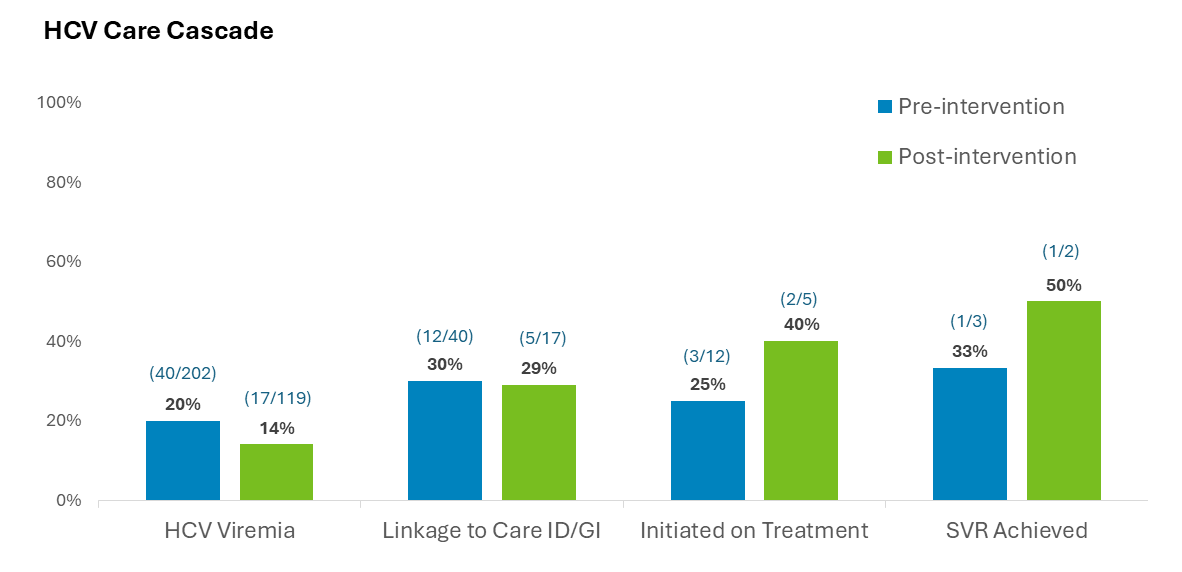
Comparing pre-intervention and post-intervention periods; HCV antibody prevalence was 202/1,772 (11.3%) vs 119/861 (13.8%), HCV viremia was present in 40/202 (19.8%) vs 17/119 (14.2%), linkage to care occurred in 12/40 (30%) vs 5/17 (29.4%), HCV treatment initiation occurred in 3/12 (25%) vs 2/5 (40%), and SVR occurred in 1/3 (33.3%) vs 1/2 (50%).
Conclusions
In the pre- and post-intervention periods, there was a high prevalence of HCV antibody positivity in Veterans visiting the ED (12% overall). The pharmacist-led HCV care navigation program improved HCV treatment initiation and SVR, reinforcing the role of pharmacists in facilitating access to curative treatment. However, barriers remain in the important step of linkage to care. This study highlights the importance of universal HCV screening, high ED HCV prevalence, and subsequent effective treatment initiation and SVR, led by pharmacist navigation. Our findings highlight the feasibility of an ED-HCV linkage to care program with pharmacist support and the urgent need for point of care test and treat programs.
Table or Figure