Background
Long COVID (LC) refers to symptoms that persist or emerge >3 months after SARS-CoV-2 infection. In this analysis of people with HIV (PWH) on stable antiretroviral therapy (ART), we examined whether their neuropsychiatric (NP) parameters before and after COVID differed by LC status.
Methods
We compared NP changes in PWH on ART pre- and post- 1st COVID, stratified by the presence of LC (i.e., LC+ vs. LC-) among PWH on over 48 weeks of ART started during acute HIV (Fiebig stage I-V) in the ongoing RV254 cohort. Cohort participants underwent NP assessments every 48 weeks during the study period, including a 4-test cognitive battery (Color Trails (CT) 1 & 2, Trail Making A and nondominant Grooved Pegboard Test), Patient Health Questionnaire (PHQ-9) for depressive mood and Distress Thermometer (DT) for stress symptoms. Since 2020, COVID incidence was systematically recorded, while post-COVID symptoms were screened during study follow-up using a standardized checklist introduced in January 2022. Wilcoxon rank-sum test was employed to compare changes in NP outcomes by LC status.
Results
Among 427 participants, the median age was 32 years (interquartile range 29-38) and 417 (97.7%) were males. LC was observed in 14% (60/427) of participants. At pre-COVID, LC+ and LC- groups did not differ significantly by age, sex, years since HIV diagnosis, CD4 count, HIV suppression, or NP test results (all p>0.05). Of the 60 LC+ participants, 36 (60%) had active LC symptoms when NP testing was performed, while the remaining NP assessments were conducted before the onset or after the resolution of LC symptoms. Neurologic symptoms, such as headache, insomnia, and cognitive and mood symptoms, were present in 43% of LC+ individuals.
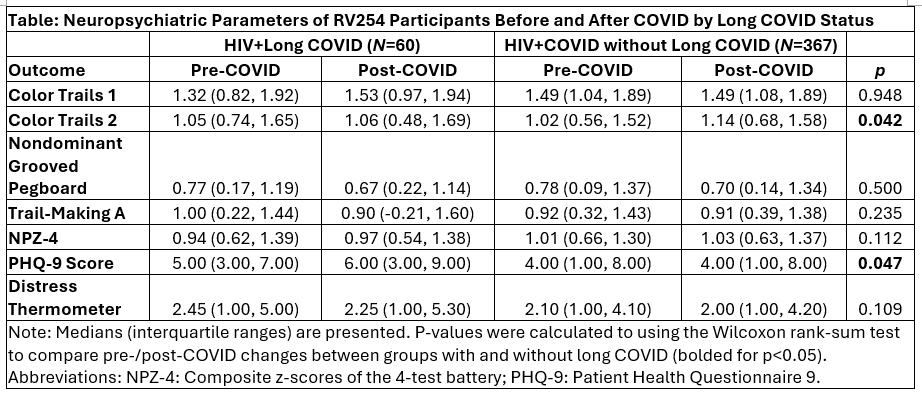
When comparing NP changes between pre- and post-COVID assessments, the LC+ group showed less improvement on CT2 (p=0.042) and a greater increase in PHQ-9 scores (p=0.047) than the LC− group (Table). When re-analyzed with only those experiencing active LC symptoms, PHQ-9 differences remained significant (p=0.015), but cognitive performance no longer differed between groups. Further analysis of cognitive performance changes using linear mixed models, adjusted for practice effects, yielded similar results (sig difference in CT2, p=0.005).
Conclusions
In a group of PWH on ART, those with LC exhibited greater increases in PHQ-9 scores and less improvement on CT2, which measures cognitive flexibility and processing speed.
Table or Figure