Background
The INSIGHT group conducted large international trials (ESPRIT, FIRST, SMART, START) evaluating different antiretroviral therapy (ART) strategies in PWH. Collectively, these studies established the benefits of continuous use of ART, including reductions in the incidence of certain cancers. Leveraging these well-characterized cohorts, we conducted a case-control study to evaluate circulating immune activation biomarkers predictive of cancers.
Methods
We identified 158 participants who developed cancer during follow up across the INSIGHT trials and selected 2 controls per case (313 participants) who were matched on the study, ART stategy group, age and randomization date. B cell activation biomarkers (sCD23, sCD27, sCD30, CXCL13) were measured from stored baseline plasma samples.Conditional logistic regression was used to study associations of each biomarker with cancer risk. Separate analyses by quartile of each biomarker were performed adjusting for age, gender, baseline CD4 T-cell count and log10 HIV-RNA, accounting for matching. Furthermore, these adjusted models were applied separately to evaluate associations with infection-related cancers, infection-unrelated cancers, and lymphomas.
Results
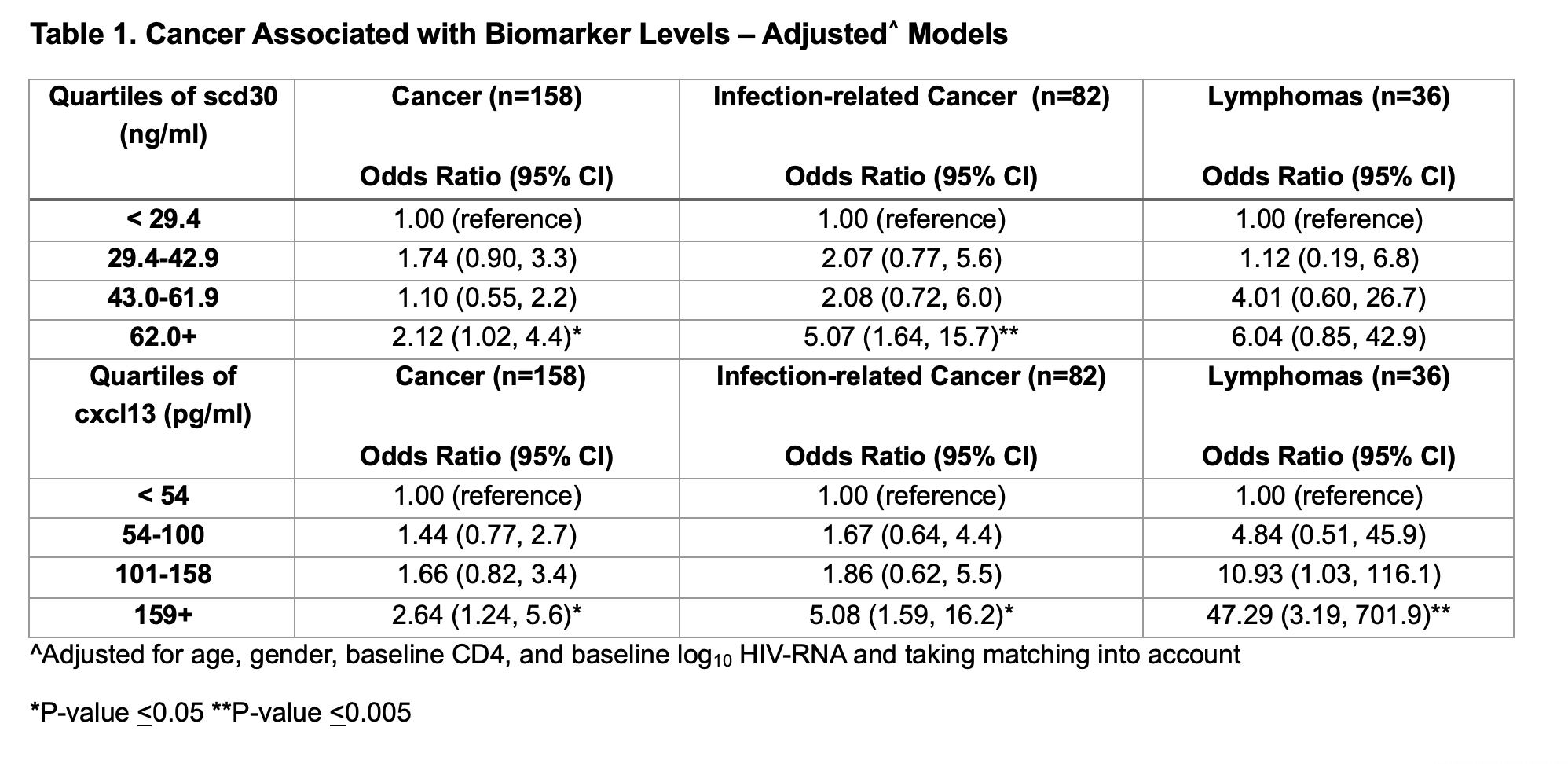
Among the 158 cases, the median time from study entry to cancer diagnosis was 2.9 years. At cancer diagnosis, the median CD4 T cell count was 525 cells/mm3, the median HIV RNA was 125 copies/mL and 79% of participants were on ART. Of the four biomarkers that were evaluated, CXCL13, a B-cell attractant signaling protein and sCD30, a marker of B-cell activation linked with lymphoma risk were associated with cancer risk. Overall, in all cases and controls using the adjusted models, the highest quartile of CXCL13 and sCD30 were each associated with increased cancer risk (Table 1). Participants with infection-unrelated cancers (n=79) and their controls were not associated with increased B-cell activation markers. In contrast, infection-related cancers (n=82) and controls were strongly associated with CXCL13 and sCD30, each conferring approximately a five-fold increase in odds of cancer in the highest quartiles. In participants with lymphoma (n=36) and controls, sCD30 levels > 62 ng/ml were associated with a six-fold increased odds of cancer, while CXCL13 levels > 159 pg/ml were associated with significant risk (OR=47).
Conclusions
B-cell activation biomarkers, specifically CXCL13 and scd30, predicted increased risk of cancer among PWH, particularly for infection-related cancers, such as lymphoma.
Table or Figure