Background
Viral latency drives HIV persistence; however, rare HIV antigen-expressing cells persist during ART despite surveillance by cytotoxic T-lymphocytes (CTL). We previously identified rare subsets of CTL-resistant, HIV-expressing CD4+ T-cells, marked by BCL-2, cytotoxic gene overexpression and metabolic quiescence. Here, we demonstrate metabolic quiescence and low oxidative stress as a mechanism of resistance in authentic reservoir clones (ARCs).
Methods
ARCs from PWH on ART were isolated direct ex vivo by limiting dilution of memory CD4+ T-cells, expanded with irradiated feeders and anti-CD3/CD28 in ARV-containing media, and profiled by CITE-seq. Competitive CTL killing assays were performed between multiple peptide-pulsed ARCs or between ARCs and CD4+ T-cells infected with ARC-derived virus. Proliferation assays with/without HIV-specific CTLs were performed in the presence or absence of Deferoxamine (DFO) to induce hypoxic stress.
Results
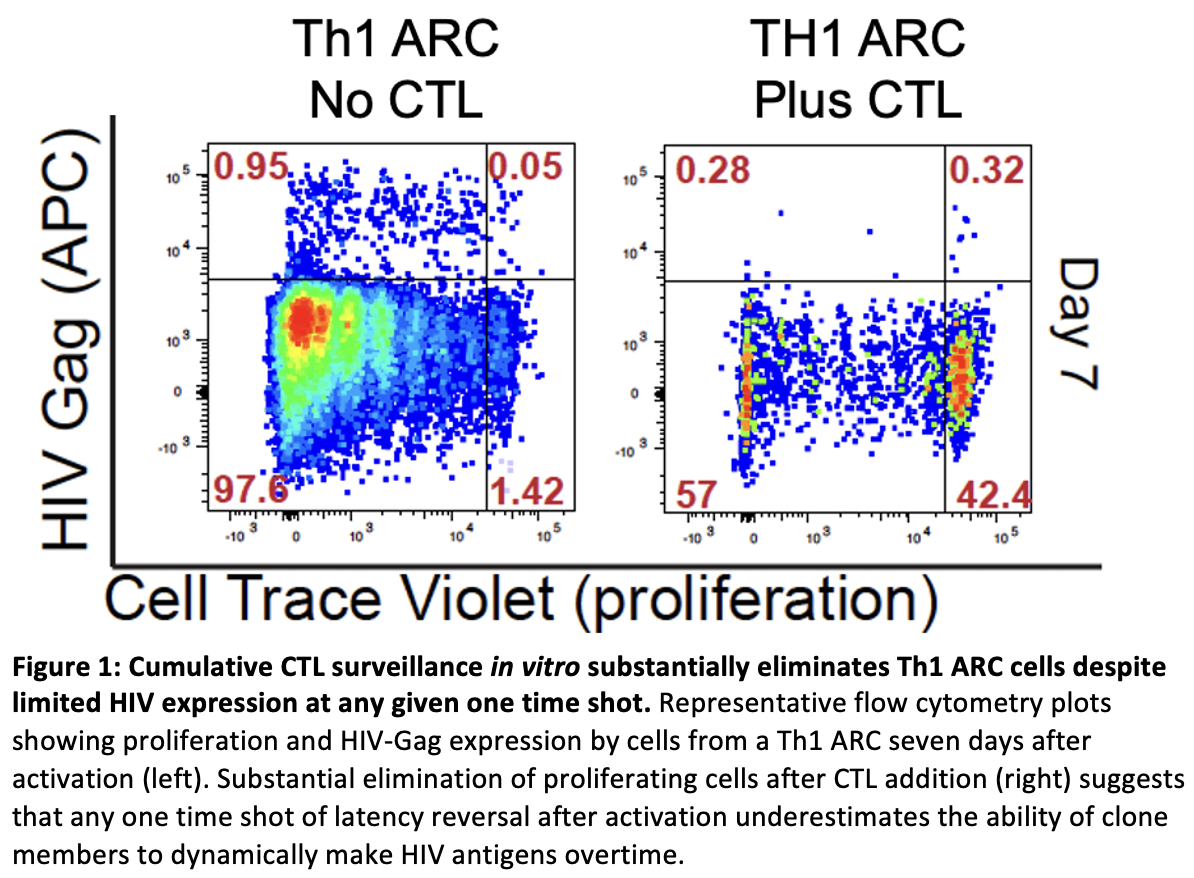
Four ARCs demonstrated Th1 profiles while one was a Treg. Cytotoxic gene signatures were elevated in all ARCs compared to uninfected clones. The Treg ARC exhibited metabolic quiescence concordant with a signature previously identified in CTL-resistant cells with reduced activation, hypoxia, and oxidative stress scores versus Th1 ARCs (p<0.0001). In peptide-pulsed killing, it displayed cell-intrinsic resistance to CTL elimination (1.2-fold reduction) compared to a Th1 ARC (3.0-fold). Resistance was confirmed in competitive killing assays: Treg ARC (no reduction in HIV-Gag+ cells), a Th1 ARC (16.0-fold reduction) and cells newly infected with Treg ARC virus (2.9-fold reduction). In proliferation assays probing CTL-resistance and latency reversal, cells from ARCs remained strikingly latent after activation (n=3, range: 0.3 to 1% Gag+ cells) despite >97% of cells from each clone initiating one round of cell division. However, proliferating cells from two Th1 ARCs were highly susceptible to CTL (25.1-fold and 38.4-fold reductions) while the Treg ARC showed considerable resistance (9.8-fold reduction). Treatment with DFO to induce hypoxic stress during culture overcame this resistance improving elimination to 27.8 fold.
Conclusions
ARCs can be eroded by cumulative CTL pressure during clonal expansion despite limited antigen expression at any snapshot. Cell-intrinsic CTL susceptibility was dependent on the oxidative stress status of ARCs and sensitization with the FDA-approved hypoxia-inducer DFO may represent a new therapeutic avenue to reduce HIV reservoirs.
Table or Figure