Background
People with HIV (PWH) are at increased risk of developing malignancies. This study aimed to estimate long term survival rates in PWH diagnosed with cancer, stratified by virus-related cancer (VRC; anal and invasive cervical cancer, hepatocellular carcinoma, Kaposi sarcoma, Hodgkin and non-Hodgkin lymphoma) and non–virus-related cancer (NVRC).
Methods
We included PWH with a VRC or NVRC diagnosis from 2008 onwards, excluding those diagnosed before or within 30 days of HIV infection and those with a cancer diagnosis prior to 2008. Baseline characteristics were compared using the Wilcoxon–Mann–Whitney test for continuous variables and chi-square or Fisher’s exact test for categorical variables; data were reported as median (interquartile range) or frequency (%). Survival curves were estimated with the Kaplan–Meier method and reported with 95% confidence intervals (95%CI). Associations with mortality were assessed using univariate and multivariable Cox proportional hazards ratio (HR) models.
Results
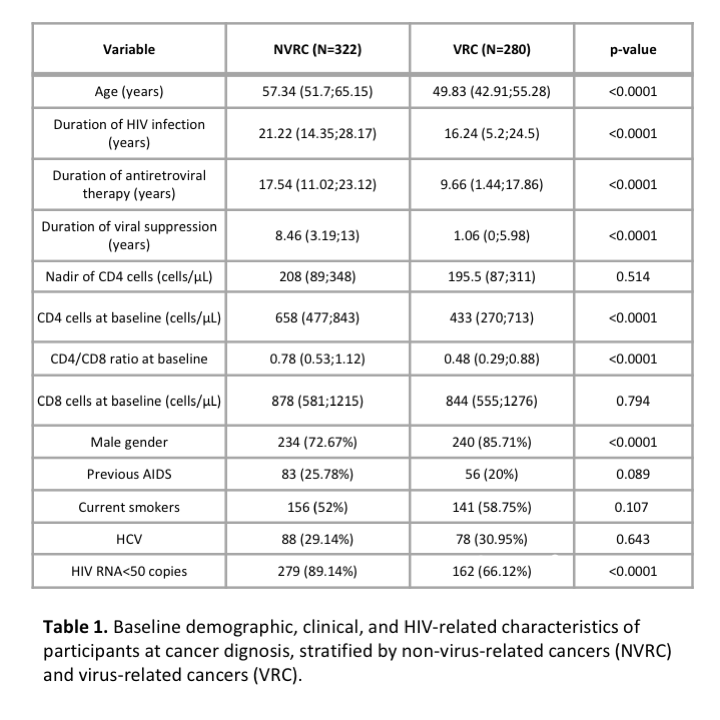
Out of 7456 PWH in follow-up, 602 individuals were included: 280 with a VRC and 322 with a NVRC. At cancer diagnosis, PWH with VRC were significantly younger (49.8 [42.9–55.3] vs. 57.3 [51.7–65.2] years), were more often male (85.7% vs. 72.7%), had shorter duration of HIV infection (16.2 [5.2–24.5] vs. 21.2 [14.4–28.2] years) and lower CD4 counts (433 [270–713] vs. 658 [477–843] cells/μL), than those with NVRC (Table 1). Overall, age at cancer diagnosis increased over time, from a median of 46.1 (40.4–51.8) years in 2008–2010 to 59.3 (55.4–65.2) years in 2023–2025. Over a median follow-up of 4 years (1–9), 180 deaths occurred (83 in VRC, 97 in NVRC). Crude 10-year survival was 65.1% [95%CI 60.4%–69.4%] in VRC and 62.5% [55.6%–68.6%] in NVRC, with 5-year survival of 74.1% [68.2%–79.1%] and 67.1% [61.0%–72.6%], respectively. No significant difference between the two groups was observed for either endpoint (p=0.148). Older age (HR 1.19 [1.09-1.30], p=0.0002), lower CD4 count (HR 0.94[0.89-1.00], p=0.033), and HCV coinfection (HR 2.69 [1.86-3.90], p<0.0001) were associated with mortality. A second primary cancer was diagnosed in 67 participants including 35 recurrences of the same tumor (16 VRC, 19 NVRC), with a crude 10-year survival after second diagnosis of 44.8% (23.6%-64.0%).
Conclusions
Long-term survival did not differ significantly between VRC and NVRC among PWH in our cohort. Over time, an increase in age at cancer diagnosis was observed.
Table or Figure