Background
Effective HIV prevention strategies are needed for all populations, including transgender women (TGW). TGW may access exogenous hormone therapies, including estrogens and gonadotropin releasing hormone agonists (to reduce testosterone production), to promote feminization and reduce dysphoria. Yet, reports of exogenous hormone effects on the pharmacokinetics (PK) and antiviral rectal tissue pharmacodynamics (PD) of oral pre-exposure prophylaxis (PrEP) drugs are conflicting and incomplete. We conducted a phase I open-label 6-period study to evaluate the relationship interaction between estrogen-based exogenous hormones and TDF/FTC PrEP in TGW.
Methods
Thirteen HIV negative, hormone-naïve/abstinent (testosterone ≥ 200 ng/dL) TGW were enrolled. Participants underwent the sequential addition or discontinuation of study drugs over 7 weeks in 6 periods, each sufficient to achieve PK steady-state: (1) no drug (baseline), (2) +daily TDF/FTC (300/200mg PO), (3) +leuprolide (11.25 mg SC), (4) +low-dose estradiol (1 mg PO), (5) +high-dose (6 mg PO) estradiol, and (6) +high-dose estradiol and without TDF/FTC. Dosing was performed under direct observation. PK/PD assessments at the end of each period included post-dose plasma, PBMC, and urine PrEP PK over 24 hours; serum estradiol, testosterone, LH, FSH; iohexol clearance-measured GFR, and rectal biopsies for PrEP anabolite concentrations and ex vivo HIV-1 biopsy challenge using cumulative (0-14 day), weight-adjusted p24 antigen as readout.
Results
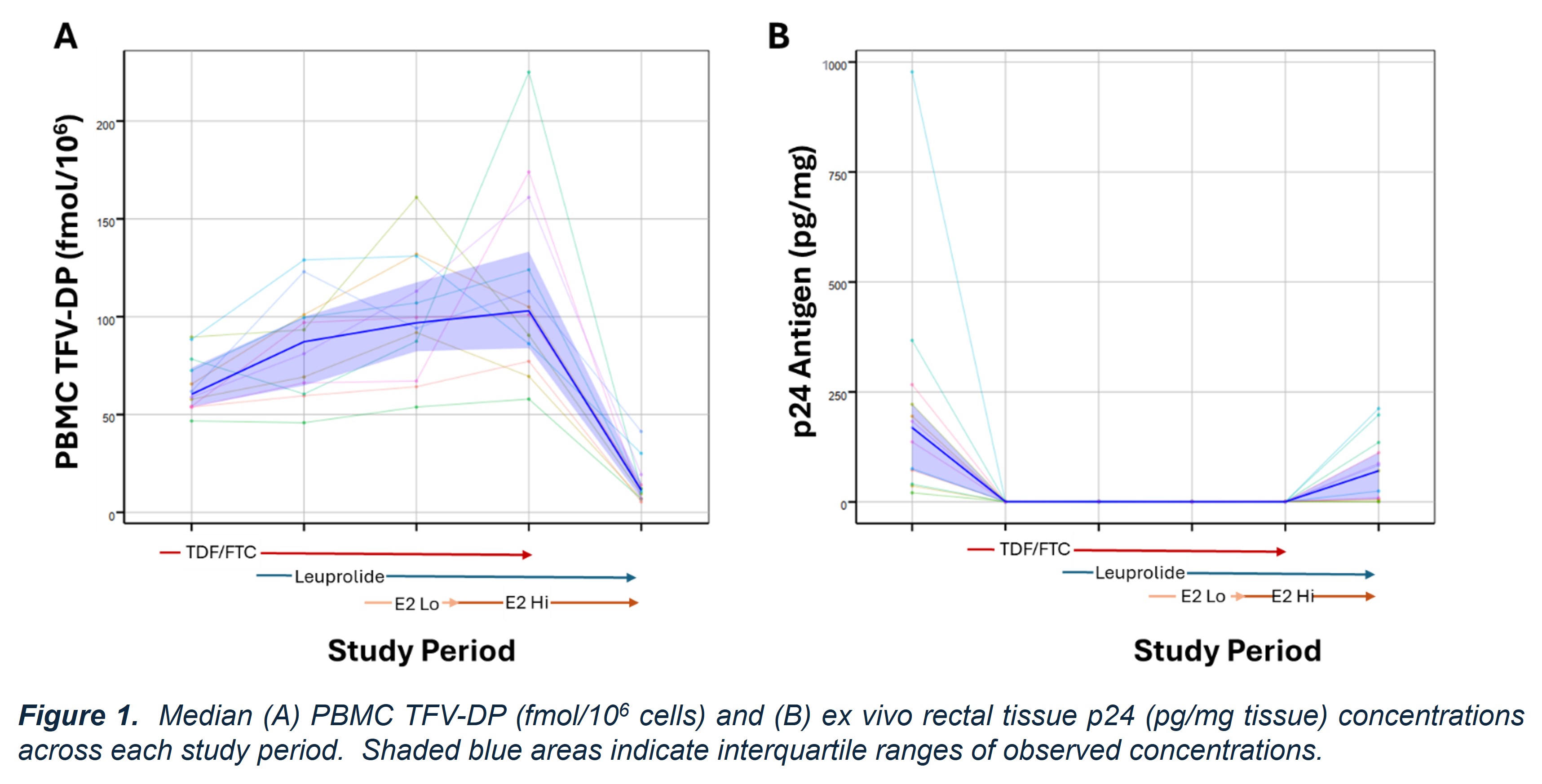
Compared to PrEP alone, PBMC TFV-DP concentrations were significantly higher post-leuprolide injection (p=0.019) and with low- (p=0.002) and high-dose estradiol (p=0.004), based on Friedman testing with pairwise Wilcoxon comparisons between drug-containing study stages. No significant changes were observed in GFR, plasma TFV/FTC PK (Cmax, AUC0-tau), 24-hour urine TFV/FTC, PBMC FTC-TP, or rectal tissue TFV-DP/FTC-TP across study periods (all p>0.05). Ex vivo HIV challenges demonstrated complete suppression of p24 antigen in all participants while using TDF/FTC for PrEP. Changes in hormone levels were as expected with hormone therapy, and high-dose estradiol concentrations were unaffected by PrEP discontinuation. No adverse events were observed.
Conclusions
Testosterone suppression and exogenous estrogens do not alter TDF/FTC PK/PD, and TDF/FTC does not reduce estradiol levels. We conclude that TDF/FTC in combination with hormonal treatments in TGW is effective in suppressing HIV and can be used jointly.
Table or Figure