Background
Though data suggest estradiol (E2) mediated activation of estrogen receptor-a can inhibit HIV transcription, previous studies using the ex vivo rectal explant challenge model have described an increase in HIV replication in tissues from women compared to men. Here, we experimentally modulated E2 within the explant culture to examine the role of E2 on HIV replication within rectal mucosal tissues.
Methods
Rectal biopsies from healthy women (n=13) and men (n=18) were incubated with HIV BaL ex vivo under ahormonal conditions or media supplemented with E2 (50 and 500 pg/ml) in triplicate. HIV reverse transcriptase (RT) activity was quantified via qRT-PCR, and relevant cytokines (n=6) and cytotoxic effector molecules (n=7) were quantified via CD8NK LegendPlex assay (n=10 women, n=9 men) in supernatants (Day 3-10). Values were normalized to biopsy weight and converted to log Area Under Curve (logAUC) for analyses. Median logAUC RT values were compared via Kruskal-Wallis test, and Spearman correlation with 1% False Discovery Rate was used to evaluate associations between HIV replication and soluble factors.
Results
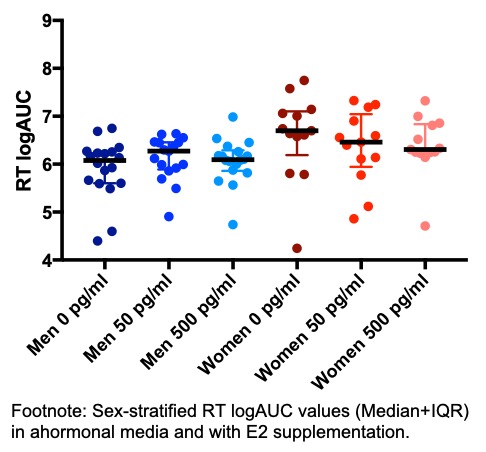
In ahormonal media, rectal tissues from women supported significantly higher HIV replication compared to tissues from men (p=0.006). E2 supplementation reduced viral replication in tissues from women in a dose-response manner, resulting in no statistical difference from biopsies donated by men (Footnote). E2 supplementation had no effect on viral replication in tissues from men. HIV replication in ahormonal media was positively associated with logAUC of IL-17A (r=0.73, q=0.0006), IFN-g (r=0.59, q=0.006), and cytotoxic effector molecules (sFas, r=0.52, q=0.015; FasL, r=0.67, q=0.002; granzyme A, r=0.70, q=0.001; granzyme B, r=0.81, q=0.0003; perforin, r=0.74, q=0.0006; granulysin r=0.70, q=0.001). These associations were not present when media was supplemented with E2.
Conclusions
These results suggest that clinically relevant sex-specific differences in HIV replication and inflammation exist within the gut mucosa that may be modulated by E2, especially among women. Given the critical importance of the gut mucosa in HIV acquisition, pathogenesis, and cure and known variations in E2 levels among women across the lifespan, molecular mechanisms contributing to E2 response within gut mucosa must be investigated further.
Table or Figure