Background
In ART-suppressed people with HIV (PWH), asymptomatic CMV suppression with letermovir reduced several inflammatory proteins causally linked to cardiovascular disease and cancer. However, an early transient increase in inflammation was observed, potentially due to suppression of CMV’s immunoregulatory viral IL-10 (vIL-10). Since women have less STAT3 signaling after IL-10 receptor (IL-10R) stimulation than men, we hypothesized that the immunologic effects of letermovir might differ by sex.
Methods
We leveraged the A5383 clinical trial of the CMV terminase inhibitor letermovir (randomized 1:1 vs no CMV treatment for 48 weeks (wks) in treated PWH with CMV), which stratified enrollment by sex and CD4 count. Plasma inflammatory proteomics (726 proteins; Olink Inflammation and Cardiometabolic Explore panels) were assessed longitudinally (median 6 samples/participant). Linear mixed models with sex-by-treatment arm interactions evaluated differential responses.
Results
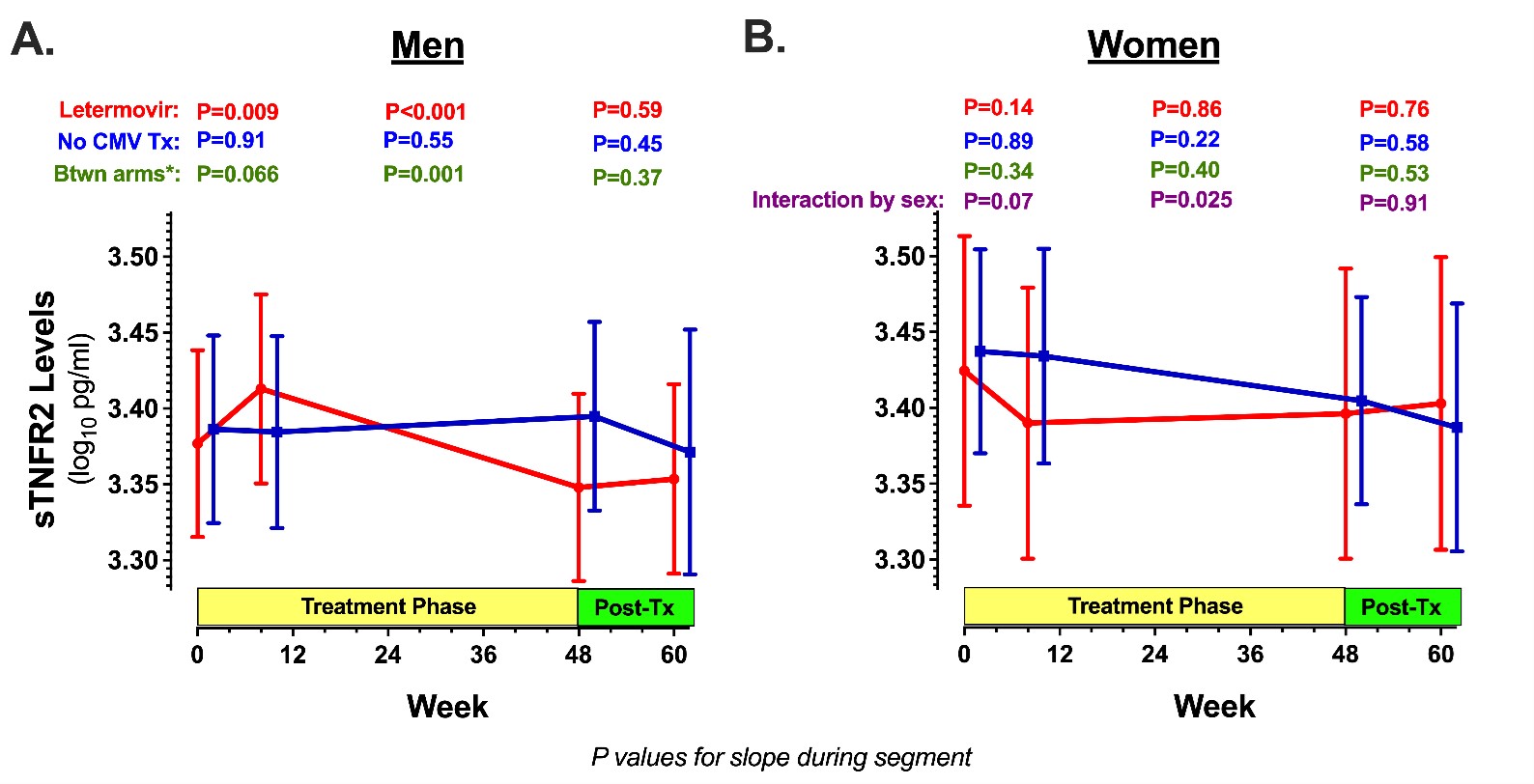
In 39 randomized participants with post-entry data (28 men, 11 women; median age 58), sex modified the effects of letermovir on several inflammatory pathways. Letermovir suppressed IL-10RA levels (marker of immunoregulatory IL-10R activity) to a greater degree than in the control arm among men (-30%, P=0.002), but there was no evidence of a letermovir-mediated decline in women (+2%, P=0.86, P for interaction=0.06). IL-10RA declines in letermovir-treated men were mirrored by transient increases in inflammation. In men, letermovir caused an early (≤8wks) transient increase in sTNFR2 levels followed by declines (A), whereas in women, sTNFR2 tended to decline early and then remain stable (p for sex interaction before and after 8wks=0.07 and 0.025, B). At 48wks, sex modified letermovir’s impact on 127/726 proteins (17%, nominal P<0.05), of which 84% declined more in women; 41 at the false discovery rate-corrected Q<0.10. Biomarkers declining to a greater degree in women belonged to KEGG pathways including apoptosis, viral protein interaction with cytokine and cytokine receptors, atherosclerosis, and cancer pathways.
Conclusions
In ART-suppressed PWH and CMV, inflammatory proteome suppression with letermovir occurred in both sexes, but was greater in women than men. Letermovir-mediated declines in immunoregulatory IL-10R activity and early transient increases in inflammation were also only observed in men, suggesting important significant sex differences in asymptomatic CMV’s immunologic effects in treated PWH.
Table or Figure