Background
Adolescent girls in East and Southern Africa (ESA) experience some of the world’s highest HIV incidence, with adolescent mothers representing a particularly vulnerable sub-population. School-based HIV prevention programs can reduce HIV risk by increasing HIV knowledge, promoting safer sexual behaviors, and supporting access to HIV prevention services, including PrEP. However, adolescent mothers, even those in school, are less likely than other adolescent girls to access such programs. We examined whether increasing access to school-based HIV prevention programs was associated with reduced condomless sex and greater PrEP interest among adolescent mothers in eight ESA countries.
Methods
We analyzed pooled data from the Population-based HIV Impact Assessment surveys (2019–2022) in Eswatini, Lesotho, Malawi, Mozambique, Tanzania, Uganda, Zambia, and Zimbabwe. The analytic sample included adolescent mothers aged 15–19. The exposure was self-reported access to school-based HIV prevention programs, with outcomes of condomless sex at last intercourse and PrEP interest. We applied g-computation with multiple imputation to estimate the population attributable effects of expanding access to school-based programming from current level (10%) to varying increased levels (25-100%), adjusting for sociodemographic covariates and survey design.
Results
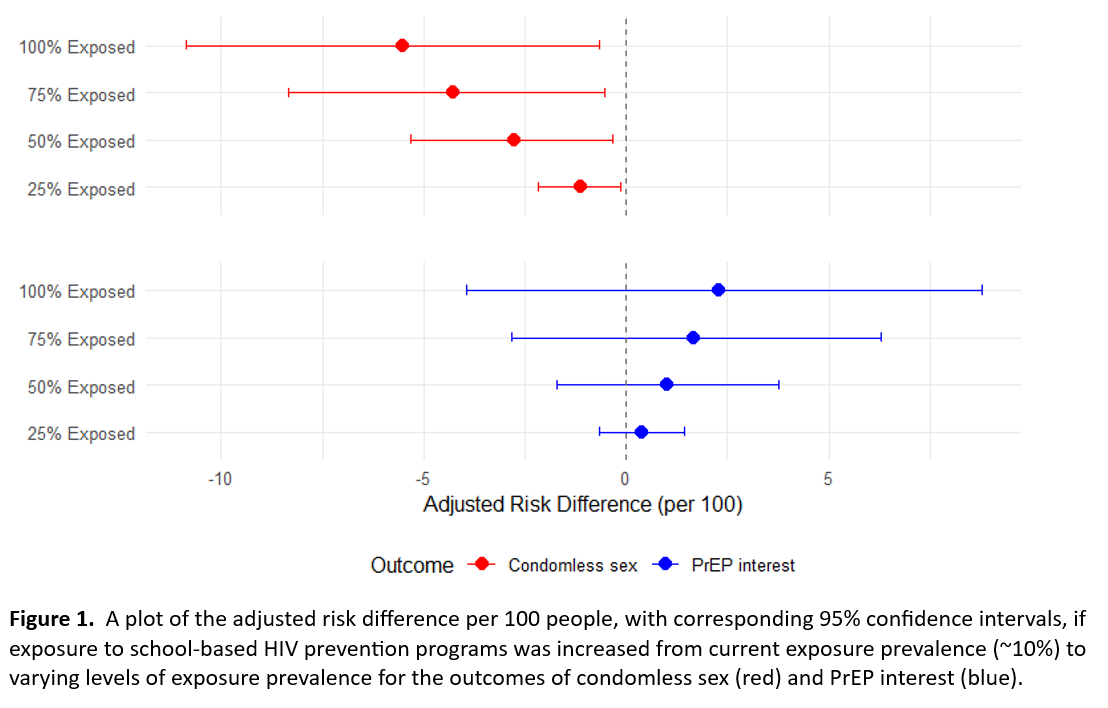
A total of 2,858 adolescent mothers were included in the pooled analysis. Increasing access to school-based HIV prevention programs was associated with a significant and increasingly larger reduction in condomless sex overall (Figure 1), with no evidence of statistical heterogeneity by country (P=0.26). In contrast, increasing access to school-based programs had minimal and non-significant impacts on PrEP interest in the pooled analysis. However, country-specific analyses revealed heterogeneity (P = 0.06), with increases in PrEP interest observed in Lesotho, Malawi, Tanzania, and Zimbabwe.
Conclusions
Expanding access to school-based HIV prevention programs, which are relatively low-touch and inexpensive, could meaningfully reduce condomless sex for adolescent mothers in ESA, suggesting important benefits for HIV risk reduction in this vulnerable sub-population. Effects on PrEP interest were less consistent, which might be explained by variation in PrEP availability. Together, these findings underscore the value of school-based programs as a scalable intervention, while also pointing to the importance of tailoring approaches across country contexts.
Table or Figure