Background
Chronic lung disease (CLD) is a major cause of morbidity and mortality among people with HIV (PWH). COPD alone affects >200 million people globally and is projected to reach 600 million cases by 2050, most of which will be in sub-Saharan Africa (SSA). HIV drives lung disease through immune dysregulation, lung infections like tuberculosis, and behavioral risks such as smoking. Most studies in SSA rely on spirometry to quantify lung disease, which limits early detection since structural lung changes may precede abnormal spirometry. Herein, we quantify prevalence and correlates of CT-based structural lung abnormalities (SLA) among people with and without HIV in Uganda.
Methods
We analyzed chest CT images from 564 participants in an observational cohort in Uganda. PWH were at least 40 years old and on anti-retroviral therapy, and PWoH were age- and sex- similar. All participants completed study questionnaires, tuberculin skin testing (TST), and chest CT scans from 2019 – 2023. A radiologist read CT images and classified SLA phenotypes based on Fleischner Society definitions. We used multivariable logistic regression to identify factors associated with SLA subtypes and assessed for effect modification by HIV serostatus in stratified models.
Results
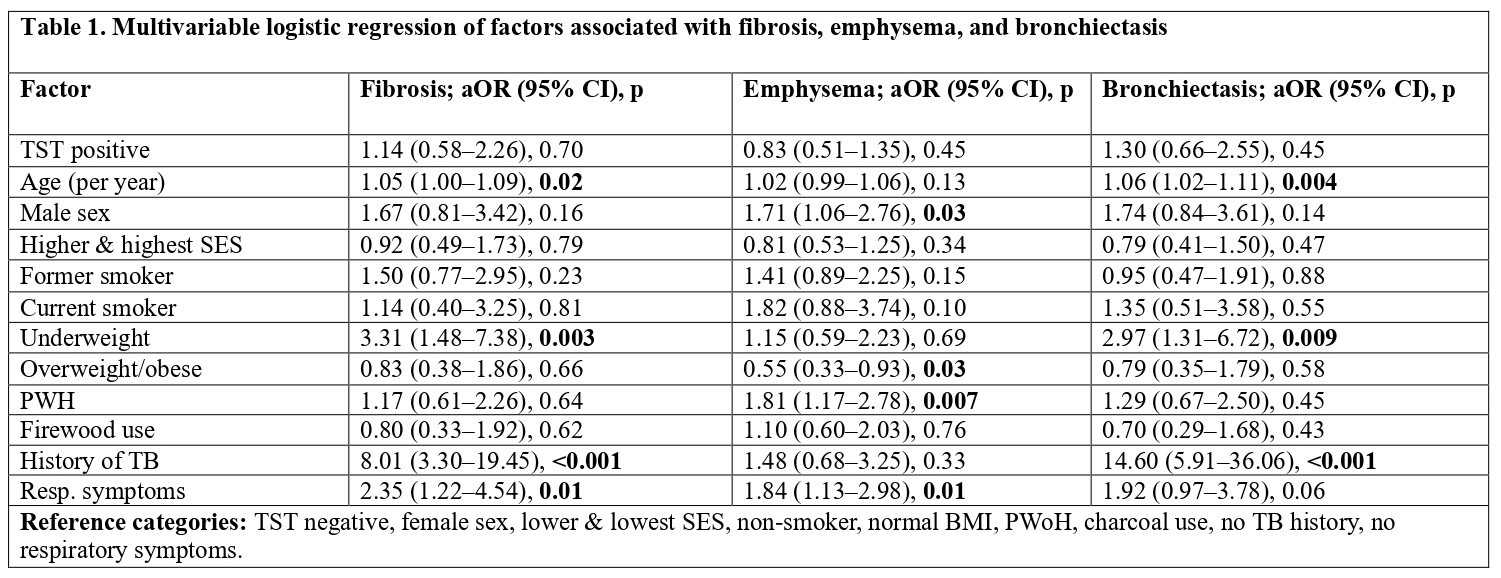
Among 564 participants (272 PWH, 292 PWoH), median age was 57 years and 49% were female. SLA were highly prevalent: nodules (43), emphysema (32%), septal thickening (18%), bronchiectasis (14%), and fibrosis (13%). PWH had higher prevalence of emphysema (40% vs. 25%, p<0.001), bronchiectasis (18% vs. 10%, p=0.003), and fibrosis (17% vs. 9%, p=0.007). Key correlates of SLA included TB history (aOR 3.28 for nodules and 3.24 for septal thickening), being underweight (aOR 2.36 for septal thickening), older age (aOR 1.02–1.06 per year for fibrosis, septal thickening, nodules, and ground glass opacities), male sex, and respiratory symptoms. Detailed correlates for fibrosis, emphysema and bronchiectasis are shown in Table 1. Stratified analyses showed stronger effects of TB history in PWH for fibrosis, bronchiectasis, and nodules, while age and being underweight were more predictive among PWoH.
Conclusions
Structural lung disease is strikingly underdiagnosed among PWH in Uganda. Strong links with prior TB and low BMI show that surviving TB is not the end and many PWH live with lasting, undetected lung injury hence the need for screening strategies in people at risk and integrated HIV–TB care for post-TB lung disease.
Table or Figure