Background
About 40% of people with HIV (PWH) have metabolic dysfunction-associated steatotic liver disease (MASLD), but simple tools for risk stratification in the clinic do not exist. BMI is limited by poor differentiation of adiposity from lean mass and variable performance by race. We evaluated whether low-cost adiposity indices are associated with MASLD in PWH and whether performance varies by race or ethnicity.
Methods
We examined participants from a prospective, cross-sectional study of SLD in PWH conducted by the NIDDK-funded HIV NASH CRN. Participants had suppressed HIV-1 RNA and underwent vibration controlled transient elastography and anthropomorphic measurements. The primary outcome was MASLD, defined as controlled attenuation parameter (CAP) ≥ 263 dB/m with at least one cardiometabolic risk factor without heavy alcohol use. Liver stiffness measurement (LSM) ≥ 8 kPa was considered clinically significant fibrosis (CSF). Adiposity indices included waist circumference (WC), body mass index (BMI), waist to height ratio (WHtR), body roundness index (BRI), relative fat mass (RFM), visceral adiposity index (VAI), and waist to hip ratio (WHR), calculated using published methods.
Results
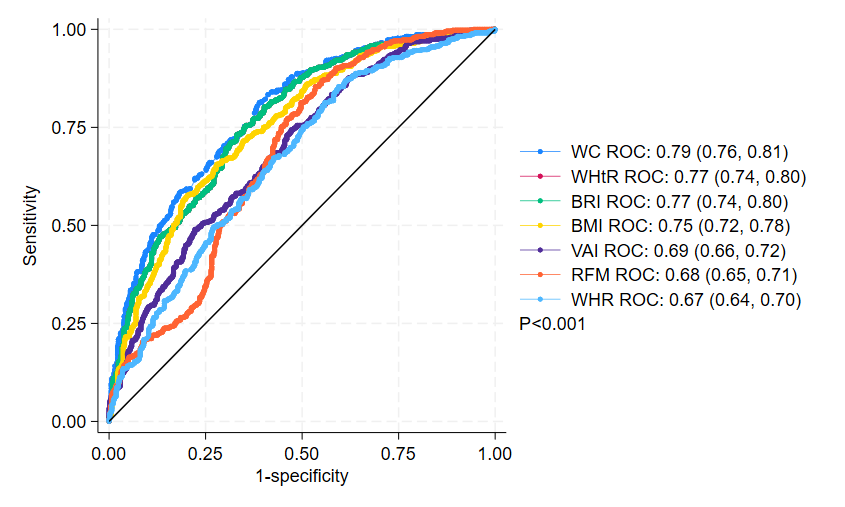
Among 1,084 PWH, 445 had MASLD, 94 had MetALD, and 88 had MASLD+CSF. PWH-MASLD were older (54.4 vs 52.8 years, p=0.04) and had higher prevalence of type 2 diabetes, hyperlipidemia, and hypertension (each p<0.001) than those without MASLD. There were also differences by race; PWH-MASLD were more likely to be Hispanic and less likely to be Black compared to those without MASLD (p<0.001). All adiposity indices were strongly associated with MASLD (p<0.001). WC, RFM, WHtR, and BRI had significant interactions with race (interaction p<0.05). WC best discriminated MASLD, with AUROC of 0.79 in the entire cohort, 0.74 in White and 0.81 in Black PWH. In Hispanic PWH, WC, WHtR, and BRI performed similarly (AUROC=0.81 each) (Figure 1: Performance of adiposity indices for discriminating MASLD).
Conclusions
In PWH, adiposity indices were strongly associated with MASLD, though their discriminatory ability varied by race and ethnicity. WC outperformed BMI in White and Black PWH, while several measures performed similarly in Hispanic PWH. Simple anthropometric indices may provide practical tools for MASLD risk assessment and could be tailored by race and ethnicity.
Table or Figure