Background
Studies have highlighted differences in metabolic health between young HIV-exposed but uninfected children (CHEU) and HIV-unexposed children. Our understanding of cardiometabolic risk factors in older CHEU is limited.
Methods
The PHACS Study in the Surveillance Monitoring for ART Toxicities Study (SMARTT) Study enrolled CHEU in the United States and Puerto Rico within 1 week of birth. We assessed the proportion of participants who met the protocol-defined metabolic trigger (BMI >95th percentile) and the prevalence of dyslipidemia (high total cholesterol, high LDL, low HDL, or high triglyceride) and insulin resistance among those who had fasting metabolic testing (2007-2016). In this analysis, follow-up began at 32 months, when children were first evaluated for meeting the BMI trigger, and ended on the date meeting the trigger or latest visit. We calculated the incidence density of meeting the trigger as the number of participants who met the trigger divided by the number of person-years (PY) at risk. Weighted prevalence was estimated after modeling the probability of having any fasting metabolic testing among those meeting the trigger.
Results
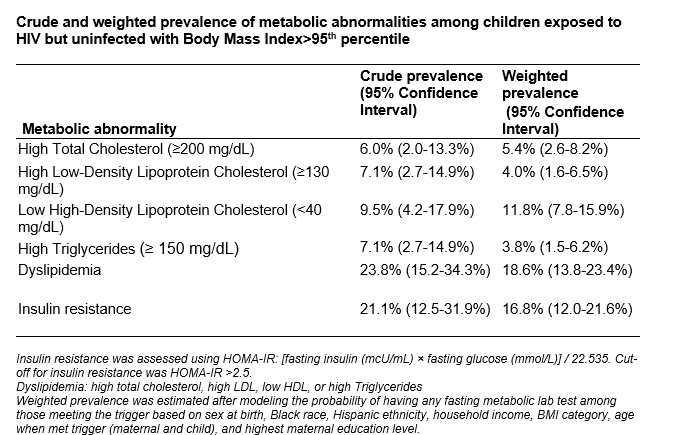
Of 1669 CHEU enrolled between 2007-2016, 421 met the metabolic trigger at age ≥32 months. The incidence density of meeting the trigger was 98.5 cases per 1000 person-years (421 participants over 4273 person-years of follow-up). Among these 421 participants, 342 had at least one fasting metabolic lab assay, and median age (IQR) was 3.9 years (3, 5), 49% were females, 60% were Black, and 52% were obese]. Mothers at baseline had a median age (IQR) of 33.4 years (29.4, 37.8), 56% were Black, 44% had a pre-pregnancy BMI ≥30 kg/m2, 75% had an HIV viral load < 200 c/mL prior to delivery, and 76% were on a protease-inhibitor regimen. Crude and weighted prevalences of metabolic abnormalities among CHEU who met the metabolic trigger are summarized in Table 1. Prevalence for dyslipidemia were crude 23.8% (95% CI 15.2-34.3%) and weighted 18.6 (95% CI 13.8-23.4%) and for insulin resistance crude 21.1% (95% CI 12.5-31.9%) and weighted 16.8% (95% CI 12-21.6%).
Conclusions
Despite averting HIV infection, CHEUs have evidence of cardiometabolic risk factors including dyslipidemia and insulin resistance. CHEUs should be monitored for long-term consequences of these metabolic complications.
Table or Figure