Background
Differences in tissue environments (TEs) and ARV pharmacokinetics/dynamics may shape HIV reservoirs. Motivated by PBMC data showing cell-associated HIV DNA and RNA levels on PI >NNRTI, we examined in the Last Gift cohort how ARV classes (PI, NNRTI, INSTI) relate to reservoir size and activity across TEs.
Methods
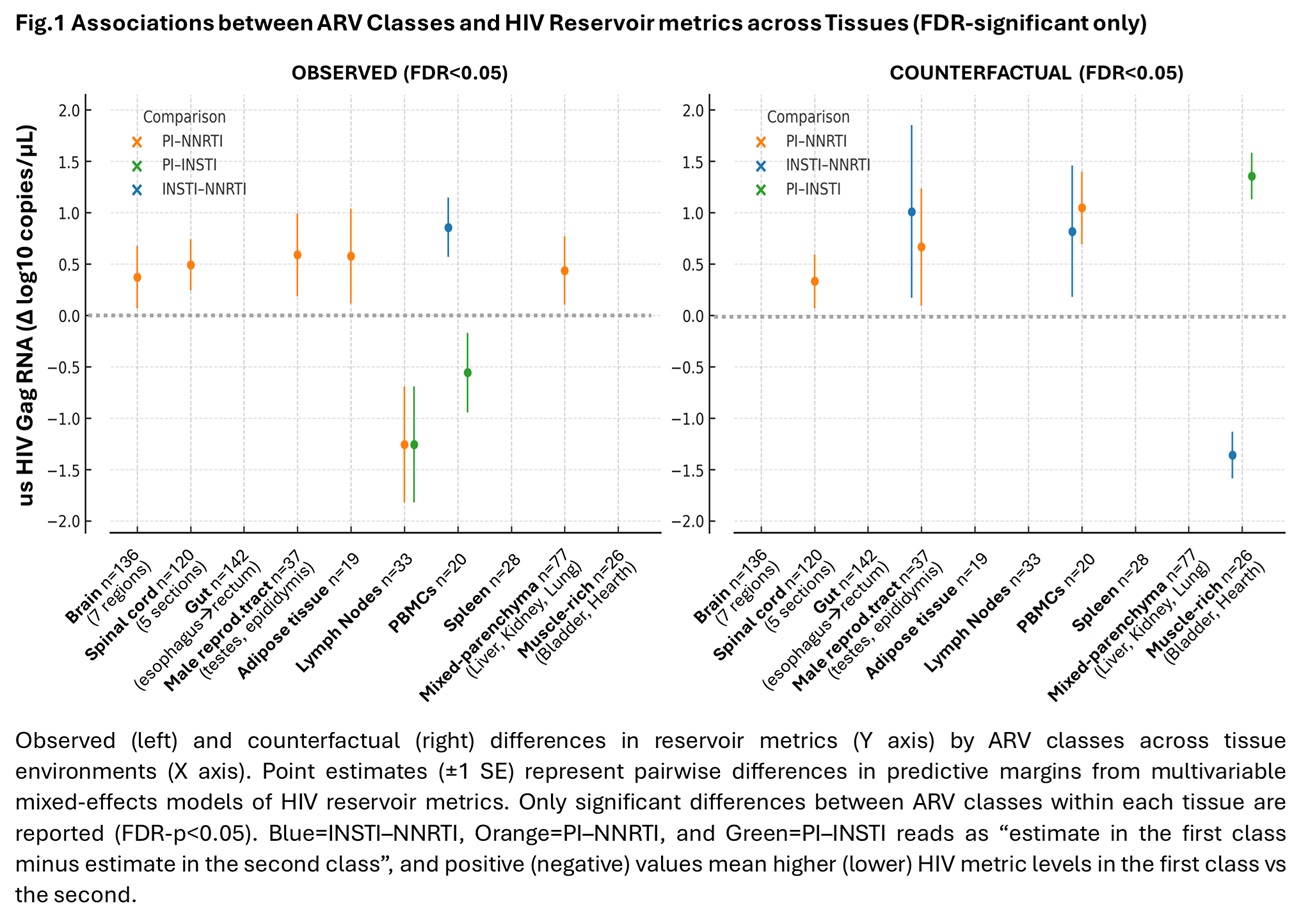
Rapid autopsies from participants on long-term suppressive ART yielded 32 tissue types grouped into 10 TEs based on pharmacokinetics/reservoir features (Fig.1). HIV DNA, unspliced HIV RNAgag, and multiply spliced HIV RNATat/Rev were quantified by ddPCR. Mixed-effects models tested ARV class (last regimen) × TE interaction on reservoir metrics adjusting for clinical/ART history covariates. Observed margins (real regimen mix) and counterfactual margins (covariates set to isolate each ARV class and assess pure class effects) underwent pairwise contrasts with false discovery rate (FDR) correction.
Results
28 participants (86% male; mean age 65, last CD4+ 260/µL) contributed 638 samples. At death, 36% each were on NNRTI and INSTI, 29% on PI, and 93% on NRTI (2NRTI+3rd 68%; dual/mixed ART 32%). Median last regimen duration was 2 years. HIV DNA levels ranked consistently across TEs (on NNRTI >INSTI ≈ PI): on PI< NNRTI in 7 TEs, on INSTI< NNRTI in 4 TEs, and on PI< INSTI in 1 TE (all FDR-p<0.05), with no class effect in brain and adipose TE. The largest differences (0.5–1 log10cp/106 cells) were found in gut, lymph nodes, testes/epididymis, and spleen, where counterfactuals aligned. HIV RNAgag showed stronger TE-dependence and wider range of between-class differences (0.2–1.2 log10cp/µL): levels on PI< INSTI/NNRTI in lymph nodes, on PI >NNRTI in 5 other TEs, and on INSTI >PI/NNRTI in PBMCs (all FDR-p<0.05; Fig.1). Counterfactuals aligned in spinal cord and testes/epididymis, changed in PBMCs (NNRTI< PI/INSTI), and showed further differences in muscle-rich TE (Fig.1). Between-class differences in HIV RNATat/Rev levels were few: on PI< NNRTI in adipose TE; on INSTI< PI/NNRTI in lymph nodes and muscle-rich TE.
Conclusions
Given slow HIV DNA turnover, between-ARV-class differences may partly reflect residual confounding and treatment-selection bias. In contrast, given rapid HIV RNA turnover, the few differences in HIV RNATat/Rev suggest similar suppression of late transcription across ARV classes in most TEs, whereas widespread tissue-specific differences in HIV RNAgag point to class-dependent effects on early transcription, with implications for sustained inflammation and tissue injury.
Table or Figure