Background
Since the Brazilian government introduced Dolutegravir (DTG)-as first-line therapy (2017), some observational studies reported discontinuation rates due to metabolic and central nervous system toxicities. There is a need to determine tolerability and identify adverse outcomes associated with increased use of Integrase inhibitors in low- and middle-income countries, where late presentation and coinfection with opportunistic infections remain common.
Methods
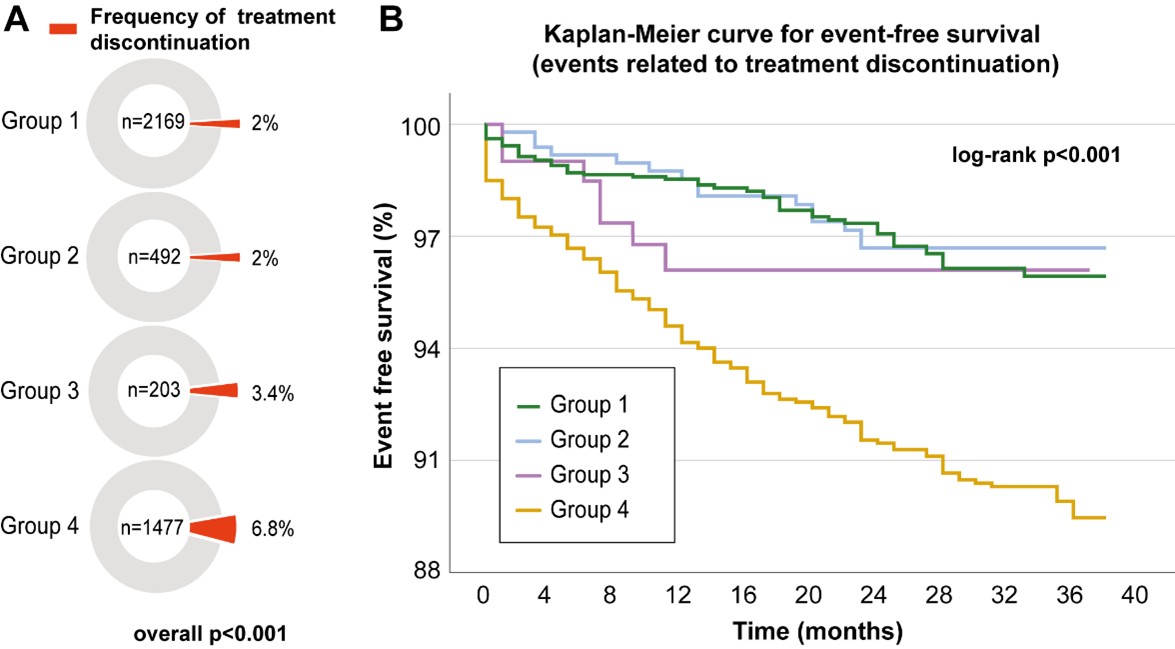
We conducted a multicenter, observational study on clinical outcomes of people living with HIV (PLWH), the CODE cohort study, who are initiating or switching to DTG-based antiretroviral therapy (ART) in Brazil. We compared the frequency of any drug-related event leading to discontinuation of DTG therapy in participants who initiating DTG or non-DTG-based ART in Brazil. Participants were grouped as: (1) Drug-naïve participants starting DTG-based ART, (2) participants on stable ART switching to DTG-based ART, (3) participants failing current ART and switching to DTG-based ART and (4) participants who started a non-DTG-based ART (data retrospectively collected from 2014 to 2016). Enrolled patients were followed for 36 months. Kaplan–Meier (K-M) analyses with log-rank (L-R) were used to compare cumulative events incidence between groups.
Results
Of 4341 PLWHIV included in CODE, 76.5% were male. Mean age was 35 years (27-46), and was higher in groups 2 and 4, as expected (p<0.001). Median viral load was higher in group 1 (68,200 copies/mm3, ,p<0.001), mean CD4 was lower in group 3 (260 cells/mm3, p<0.001). The most common discontinuation event were: adverse events (AEs), serious AEs, anti-HIV drug resistance, treatment non-adherence, ARTchange, and death. More treatment discontinuations were observed in group 4 (6.8% vs. <4% in the other groups, p <0.001) (Figure 1A), with AEs being the most common discontinuation event in group 4 (n = 36), while only one AE associated with discontinuation occurred in the others groups. K-M curves shows that the group 4 had significantly lower frequencies for event-free (event related to treatment discontinuation) survival when compared with the other study groups (Figure 1B).
Conclusions
DTG-based regimens were significantly associated with less drug-related discontinuation occurrence than non-DTG regimens.
Table or Figure